

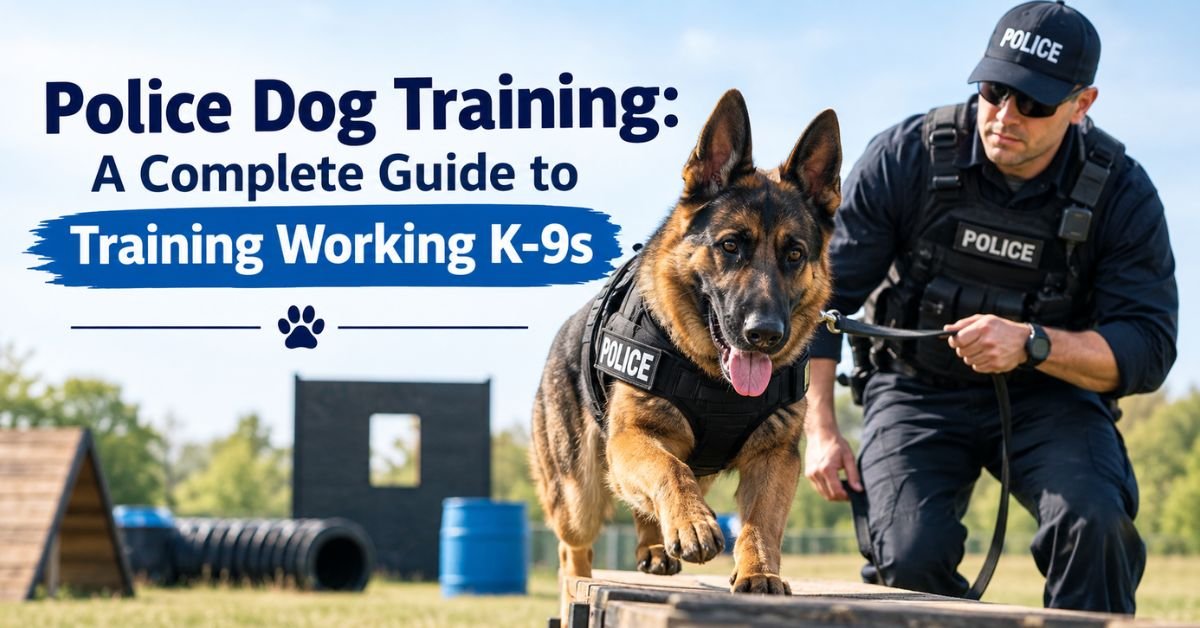
Police dog training is far more specialized than teaching a family dog to sit, stay, or walk politely on a leash. A working K-9 may be expected to search large areas, identify specific odors, track a person, locate missing individuals, detect prohibited substances, or work safely alongside a handler in stressful environments.
The best police dog training programs do not focus only on obedience. They develop a dog’s ability to concentrate, work around distractions, respond reliably to a handler, recover from stressful situations, and perform a specific job consistently.
Professional police K-9 programs also recognize that dogs are individuals. A German Shepherd or Belgian Malinois may be well suited to certain working roles, but breed alone does not guarantee that a dog will succeed. Motivation, health, environmental confidence, trainability, physical condition, and the dog’s willingness to work are all important considerations.
For pet owners, learning about police dog training can also provide useful lessons for everyday training. Short sessions, clear communication, appropriate rewards, gradual exposure to distractions, and careful attention to the dog’s physical and emotional condition can improve many forms of canine training.
What Is Police Dog Training?
Police dog training is a structured process that prepares a dog and handler to work together in a specific law-enforcement role.
Depending on the K-9’s assignment, training may involve:
- Basic and advanced obedience
- Tracking and trailing
- Human scent detection
- Narcotics detection
- Explosive detection
- Search work
- Evidence searches
- Area searches
- Handler communication
- Environmental confidence
- Controlled public behavior
- Physical conditioning
- Scenario-based work
Police K-9 teams may specialize rather than perform every possible task. Detection dogs, for example, learn to associate target odors with a reward and communicate the discovery to their handler.
The handler is equally important. A successful K-9 team depends on the dog and handler understanding each other and practicing regularly. The American Kennel Club notes that handlers commonly continue daily reinforcement after professional trainers establish the initial skills.
Why Are Police Dogs Trained Differently From Pet Dogs?
A pet dog generally needs practical household skills. A police dog may need to perform the same behavior repeatedly while surrounded by unfamiliar people, loud noises, unusual surfaces, vehicles, buildings, crowds, weather changes, and other distractions.
That means professional training must build reliability under increasingly difficult conditions.
For example, teaching a dog to sit in a quiet room is relatively simple. Asking the same dog to remain responsive while working around unfamiliar sounds and smells requires a much stronger foundation.
Police dog training therefore progresses from simple behaviors toward controlled, realistic working environments.
The goal is not simply to make a dog obedient. The goal is to create a reliable working partnership between the dog and handler.
Common Types of Police Dogs
Police K-9s can perform different jobs depending on the agency and the dog’s specialization.
1. Detection Dogs
Detection dogs use their highly developed sense of smell to locate specific target odors.
Depending on their assignment, they may be trained to detect:
- Narcotics
- Explosives
- Human remains
- Certain biological odors
- Contraband
- Other target substances
Detection training commonly uses a reward-based association: the dog learns that identifying the correct target odor leads to something valuable, such as a toy, food reward, or play.
2. Tracking and Trailing Dogs
Tracking dogs are trained to follow human scent over an area.
Their work may involve:
- Locating missing people
- Following a person’s trail
- Searching outdoor areas
- Working across different surfaces
- Following scent in changing environmental conditions
Tracking requires concentration and persistence. The dog must learn to continue working rather than becoming distracted by every interesting smell in the environment.
3. Search Dogs
Search dogs may assist in locating people in large or difficult environments.
Depending on the assignment, search work can involve buildings, open areas, disaster environments, or other locations.
These dogs require confidence because working environments can include unfamiliar footing, noises, objects, and confined spaces.
4. Patrol K-9s
Patrol dogs may receive specialized training for law-enforcement operations. This can include advanced obedience, controlled searching, tracking, and other operational skills.
Because patrol work can involve significant safety risks, specialized tasks should be taught by qualified professional K-9 trainers and agencies rather than copied from informal internet tutorials.
What Makes a Good Police Dog?
Not every dog is suited to professional K-9 work.
A working candidate may be evaluated for several characteristics.
Strong Motivation
A dog needs a reason to keep working. For some dogs, a toy is extremely motivating. Others are highly food motivated, while some respond strongly to praise or interaction.
There is no universal reward that works equally well for every dog. Individual motivation matters.
Environmental Confidence
Police dogs may encounter:
- Stairs
- Slippery surfaces
- Vehicles
- Crowds
- Loud noises
- Dark rooms
- Unfamiliar buildings
- Outdoor terrain
A dog that becomes overwhelmed by ordinary environmental changes may struggle with professional working conditions.
Focus
A working dog must be able to concentrate on the task despite distractions.
Focus is developed progressively rather than demanded immediately. Trainers can begin in quiet environments and gradually introduce more challenging distractions.
Physical Fitness
Police dogs can perform demanding physical work. Their conditioning should therefore be appropriate for their age, health, workload, and veterinary status.
High-intensity or prolonged exercise can cause fatigue, dehydration, electrolyte disturbances, and heat-related problems. Appropriate conditioning and acclimation can reduce these risks.
Recoverability
A valuable working trait is the ability to recover after encountering something surprising or stressful.
This does not mean deliberately frightening a dog. Instead, professional trainers can introduce novel experiences gradually and reward calm, appropriate responses.
Handler Engagement
The dog should be willing to communicate and work with its handler.
A strong working relationship can make training more consistent and help the handler recognize changes in the dog’s behavior, motivation, fatigue, and performance.
🩺 Veterinary Expert Advice & Disclaimer:
“Working dogs need training plans that account for physical fitness, recovery, hydration, and individual health rather than focusing only on performance. Any dog beginning demanding work should receive appropriate veterinary assessment, and signs of pain, overheating, unusual fatigue, or behavioral changes should be investigated promptly.”
— Medically Reviewed & Verified for Doggopulse
The Foundations of Police Dog Training
Professional K-9 training generally builds skills progressively.
Step 1: Basic Obedience
Before specialized work begins, the dog needs reliable foundational behaviors.
Common skills include:
- Sit
- Down
- Stay
- Recall
- Loose-leash walking
- Position changes
- Attention to the handler
- Impulse control
These behaviors create communication between dog and handler.
Step 2: Reward Development
Reward selection is a major part of modern training.
Rewards can include:
- Food
- Toys
- Tug games
- Ball play
- Praise
- Access to a preferred activity
The reward should actually matter to the individual dog.
A toy that excites one dog may be completely uninteresting to another. Trainers can identify the dog’s preferred rewards and gradually build stronger motivation for appropriate working behavior.
Step 3: Marker Training
A marker can communicate the exact moment the dog performs the desired behavior.
For example, a trainer might use a short verbal marker such as “yes” immediately after the correct behavior and then provide the reward.
This helps the dog understand what earned reinforcement.
Reward-based training is widely used because the trainer can clearly reinforce desirable behavior while building the dog’s willingness to participate.
Step 4: Increasing Distractions
Once a behavior is reliable in a quiet environment, distractions can be introduced gradually.
A progression might involve:
- Quiet room
- Yard
- Training facility
- Outdoor location
- Mild distractions
- More complex environments
- Controlled operational scenarios
Moving too quickly can create confusion and reduce reliability.
Police Dog Scent Training
Scent work is one of the most specialized areas of working-dog training.
Dogs naturally investigate their environment through smell, but professional detection requires much more than simply having a good nose.
The dog must learn:
- What target odor matters.
- That locating the odor leads to reinforcement.
- How to search systematically.
- How to remain focused.
- How to communicate a trained indication to the handler.
A successful detection exercise should not simply reward random sniffing. The dog needs a clear relationship between the trained target and the reinforcement.
Professional detection programs can take substantial time, and different dogs may require different training approaches.
Police Dog Tracking Training
Tracking is different from general scent detection.
The dog must learn to follow relevant human scent while working through an environment containing many competing odors.
Training can gradually introduce:
- Short trails
- Longer trails
- Different surfaces
- Older trails
- Turns
- Environmental distractions
- Changing weather conditions
The difficulty should increase according to the dog’s demonstrated ability.
A dog that succeeds on a short, fresh trail should not immediately be expected to solve a complicated track under difficult environmental conditions.
Obedience and Impulse Control
Police dogs need reliable communication with their handlers.
Impulse control can help the dog wait for instructions rather than immediately reacting to everything in its environment.
Useful exercises may include:
- Waiting for permission
- Maintaining position
- Returning attention to the handler
- Ignoring non-target distractions
- Remaining calm between work sessions
- Switching from excitement to controlled behavior
These skills are also useful for ordinary companion dogs.
Socialization for Working Dogs
Socialization does not mean forcing a dog to interact with everyone.
Instead, it means helping the dog become comfortable and appropriately responsive around different people, environments, surfaces, sounds, and situations.
A working dog should learn that unfamiliar environments do not automatically mean danger.
Gradual exposure is generally more useful than overwhelming the dog with intense stimuli.
If a dog becomes frightened, panicked, or unable to recover, the training difficulty should be reduced and the situation reassessed.
Stress, Fatigue, and Recovery
Physical conditioning is an important part of working-dog welfare.
High-intensity exercise increases metabolic demand and produces heat. During prolonged exercise, dehydration and electrolyte disturbances can contribute to fatigue and potentially dangerous exhaustion.
Handlers should monitor:
- Excessive or unusual panting
- Reduced responsiveness
- Weakness
- Unusual slowing
- Difficulty recovering after exercise
- Reluctance to continue
- Changes in gait
- Signs of pain
- Abnormal behavior
A dog should not be pushed through unexplained physical problems simply because it is being trained for work.
Rest and recovery are part of performance management, not signs of poor discipline.
Feeding Guidelines for Working and Police Dogs
Nutrition should be individualized according to the dog’s body condition, workload, environment, age, and health.
Working dogs can have substantially different energy requirements from sedentary companion dogs. Merck Veterinary Manual notes that caloric needs may increase with work or stress and that feeding amounts should be adjusted based on body weight, body condition, performance, and overall health.
Choose a Complete and Balanced Diet
A professional working dog should receive a nutritionally complete diet appropriate for its life stage and workload.
Do not assume that a high-protein or high-fat food is automatically appropriate for every working dog.
The right diet depends on the actual workload and the dog’s individual response.
Monitor Body Condition
Body weight alone does not tell the entire story.
A working dog should be evaluated for:
- Body condition
- Muscle condition
- Coat quality
- Energy
- Recovery
- Stool quality
- Appetite
- Working performance
If the dog’s workload increases significantly, nutritional requirements may need to change.
Keep Fresh Water Available
Hydration is particularly important during physical work.
Fresh water should be readily available, and working routines should include appropriate opportunities for drinking. Merck Veterinary Manual emphasizes the importance of water availability for working dogs.
Use Training Rewards Wisely
Training treats contribute calories.
Small rewards can be useful during repeated training sessions, but the daily food allowance should be considered as a whole.
Using a portion of the dog’s regular food as training reinforcement can sometimes help control total calories.
For highly challenging training, a more valuable reward may be appropriate, provided it fits the dog’s overall nutritional plan.
Police Dog Training Schedule
There is no single schedule suitable for every K-9.
A balanced training plan may include different types of work rather than performing the hardest exercises every day.
A general example could include:
| Training Area | Typical Goal | Example Progression |
| Obedience | Reliable handler communication | Basic commands → distractions → advanced environments |
| Scent Work | Accurate target detection | Simple odor work → varied environments → operational scenarios |
| Tracking | Following relevant human scent | Short trail → longer trail → environmental challenges |
| Conditioning | Strength and endurance | Controlled exercise → increased workload → recovery monitoring |
This table is a planning framework, not a prescription for an operational police K-9 program.
Common Training Mistakes
Expecting Too Much Too Soon
One of the most common mistakes is increasing difficulty before the dog understands the previous step.
If the dog repeatedly fails, the answer is often to make the exercise easier and rebuild the behavior.
Using the Wrong Reward
A reward only works if the dog actually values it.
For some dogs, food is excellent. Others work harder for a toy, game, praise, or another activity.
Ignoring Stress Signals
A dog that is overwhelmed may stop learning effectively.
Stress, fear, physical discomfort, and exhaustion should not simply be interpreted as stubbornness.
Training Only in One Location
A behavior that works perfectly in a quiet training room may disappear in a busy outdoor environment.
Generalization requires controlled practice in different locations.
Neglecting Recovery
Working dogs are athletes in many respects. Repeated intense work without adequate recovery can increase fatigue and injury risk.
Appropriate conditioning, warm-up, environmental acclimation, hydration, and recovery are important parts of a responsible program.
Positive Reinforcement in Police Dog Training
Reward-based training can be highly useful because it gives the dog clear information about which behavior is desirable.
Rewards may include food, toys, play, praise, or access to another preferred activity.
The important point is timing.
If the reward arrives too late, the dog may not understand what behavior earned it.
For example, if the trainer wants to reinforce a calm indication, the reward should be connected closely to the correct behavior.
Professional K-9 training may use specialized methods depending on the discipline, agency, trainer, and operational requirements. Pet owners should not attempt to reproduce specialized apprehension or operational exercises without qualified instruction.
How Long Does Police Dog Training Take?
Training duration varies significantly depending on the dog’s role, starting abilities, organization, certification requirements, and level of specialization.
Some detection and working-dog programs can take many months or longer to develop reliable operational performance. The AKC reports that some police scent-detection training programs may take two to three years when considering the full development of specialized skills.
Training also does not necessarily end after initial certification.
Skills require ongoing reinforcement and evaluation.
Can Any Dog Become a Police Dog?
No.
Many dogs can learn useful obedience and scent-work skills, but professional police K-9 work requires a particular combination of physical ability, motivation, temperament, environmental stability, and trainability.
Breed can influence working tendencies, but it is not the only consideration.
Commonly encountered police and working breeds include Belgian Malinois, German Shepherd Dogs, Dutch Shepherds, Bloodhounds, and Labrador Retrievers.
Individual dogs can still surprise trainers. There are documented examples of rescue and mixed-breed dogs succeeding in specialized police work when given an opportunity and appropriate training.
Police Dog Training vs. Training a Family Dog
The underlying learning principles can overlap, but the goals are different.
A family dog may need to learn:
- Sit
- Stay
- Recall
- Loose-leash walking
- Calm greetings
- Household manners
A police K-9 may need to perform highly specialized behaviors under difficult environmental conditions.
For most dog owners, there is no need to recreate professional police-dog exercises. Instead, owners can borrow the useful fundamentals:
- Keep sessions short and purposeful.
- Reward behaviors you want to see again.
- Increase distractions gradually.
- Use rewards the dog genuinely values.
- Practice in different environments.
- Give the dog time to recover.
- Avoid overwhelming the dog.
- Monitor physical health and body condition.
Safety and Welfare Considerations
Police K-9 training carries responsibilities beyond performance.
A responsible program should consider the dog’s physical health, emotional welfare, training progression, recovery, and ability to cope with its assigned work.
The goal should never be to create a dog that is simply highly aroused or uncontrollable.
A reliable working dog needs appropriate control and clear communication with its handler.
Training professionals should also use standardized assessment and certification processes where applicable. Government-backed efforts such as the Scientific Working Group for Dog and Orthogonal Detector Guidelines have historically addressed standards and certification issues for detector-dog teams.
Frequently Asked Questions About Police Dog Training
1. What is the most important part of police dog training?
There is no single skill that determines success. A strong foundation usually combines obedience, motivation, environmental confidence, physical fitness, specialized task training, and reliable communication between the dog and handler.
2. What breeds are commonly used for police dog training?
Belgian Malinois, German Shepherd Dogs, Dutch Shepherds, Bloodhounds, and Labrador Retrievers are among breeds commonly associated with police or specialized working roles. However, individual temperament, motivation, health, and working ability matter as well.
3. Can I train my pet dog like a police dog?
You can teach your dog many foundational skills used in working-dog training, such as obedience, scent games, tracking-style exercises, focus, and impulse control. Specialized law-enforcement tasks, particularly operational apprehension work, should be left to qualified professional trainers.
4. How do police dogs learn scent detection?
The dog is taught to associate a specific target odor with a valuable reward. As the skill develops, the dog learns to search for the target odor among distractions and perform a trained indication when the target is located.
Final Thoughts
Police dog training is a demanding combination of canine learning, physical conditioning, specialized scent or search skills, handler communication, and ongoing practice.
The most successful working-dog programs do not treat every dog exactly the same. They consider what motivates the individual dog, build skills progressively, introduce distractions carefully, and monitor physical and behavioral welfare throughout training.
For ordinary dog owners, the biggest lesson is simple: effective training is built through clear communication, appropriate reinforcement, gradual progression, and consistency.
A police K-9 may eventually perform highly specialized work, but that reliability begins with the same foundation every well-trained dog needs a clear understanding of what is expected, a reason to participate, and a handler who knows how to communicate effectively.
| Training Area | Primary Objective | Key Training Focus | Welfare Consideration |
|---|---|---|---|
| Basic Obedience | Reliable handler communication | Sit, stay, recall, position, impulse control | Keep sessions manageable |
| Detection Work | Locate target odor | Search, odor association, trained indication | Avoid excessive fatigue and frustration |
| Tracking | Follow human scent | Scent discrimination, persistence, environmental variation | Progress difficulty gradually |
| Physical Conditioning | Support working performance | Strength, endurance, recovery | Monitor heat, hydration, pain, and fatigue |
📚 Scientific References & Sources
- Merck Veterinary Manual – Fatigue and Exercise in Dogs
- Merck Veterinary Manual – Feeding Practices in Small Animals
- American Kennel Club – Types of Police Dogs and How They Use Their Noses
- American Kennel Club – What Do K-9 Police Dogs Do?
- National Institute of Justice – Dog and Sensor Subcommittee and Detector Dog Standards

Muhammad Ahad — Passionate writer sharing informative, engaging, and easy-to-read articles across different topics. Focused on delivering valuable content that helps readers learn, explore, and stay inspired every day.