

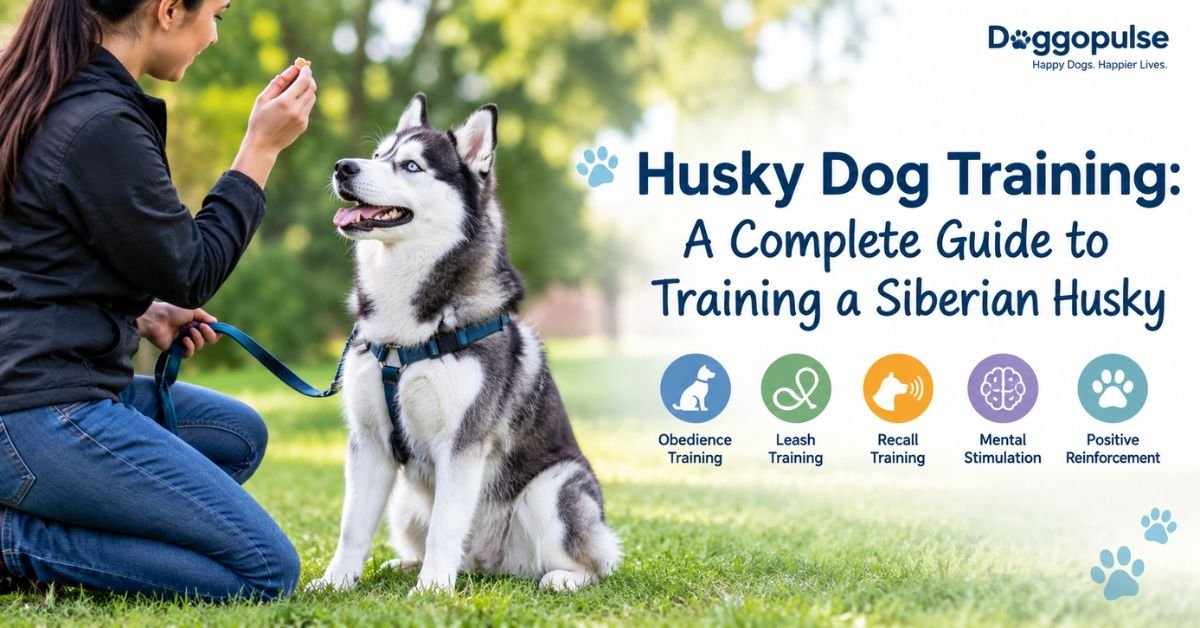
Training a Husky can be incredibly rewarding, but it can also test your patience. Siberian Huskies are intelligent, energetic, social, curious, and often independent-minded husky dog training. They can learn commands quickly, yet they may decide that something more interesting is happening somewhere else.
Successful husky dog training is therefore less about forcing obedience and more about building motivation, consistency, communication, and trust.
Siberian Huskies generally respond well to positive reinforcement, especially when training is engaging and rewarding. Breed guidance from the American Kennel Club and veterinary sources also highlights the importance of early socialization, consistent training, mental stimulation, exercise, and secure management because Huskies can be prone to roaming and have a strong prey drive.
Whether you have a Husky puppy, an adolescent dog, or an adult Husky that has developed frustrating habits, the same basic principle applies: teach the behavior you want, reward it clearly, and make the correct choice easier than the wrong one.
Overview: Why Husky Dog Training Is Different
A Siberian Husky is not necessarily difficult to train because it lacks intelligence. In many cases, the opposite is true.
Huskies are capable of learning quickly, but they can also be independent and easily distracted. Their history as working sled dogs means they were bred for endurance, movement, and cooperation with humans rather than simply sitting beside a person waiting for instructions.
This can affect everyday training.
For example, your Husky may understand the command “come” perfectly well in your living room but ignore it when a squirrel runs across the yard. That does not necessarily mean your dog has forgotten the command. The outdoor environment simply provides a much stronger competing motivation.
Effective Siberian Husky training therefore involves gradually increasing distractions instead of expecting a dog to perform a newly learned behavior perfectly everywhere.
The Main Goals of Husky Training
A well-rounded training program should teach your Husky to:
- Respond reliably to their name
- Come when called
- Walk calmly on a leash
- Sit and lie down on cue
- Stay or remain in place temporarily
- Leave unsafe or unwanted objects
- Wait at doors and gates
- Settle calmly inside the home
- Accept handling and grooming
- Behave appropriately around people and dogs
- Focus on you despite distractions
- Remain safely contained outdoors
Training is not simply about making a dog obedient. Good training can improve communication and give dogs more freedom because owners can manage them more safely.
The RSPCA notes that basic obedience training can help dogs safely enjoy activities such as walks, social interactions, and off-leash opportunities where appropriate.
Understanding the Husky Before You Start Training
Before choosing a training strategy, it helps to understand common characteristics of the breed.
Huskies Are Highly Energetic
A Husky that has excess physical and mental energy may have difficulty concentrating.
This does not mean you should exhaust your dog before every training session. Instead, provide appropriate daily exercise and mental enrichment while keeping formal training sessions short and focused.
Veterinary breed guidance notes that Huskies need substantial daily exercise and may become overactive or destructive when their exercise needs are not adequately met.
Huskies Can Be Independent
Your dog may sometimes appear as if they are asking, “What’s in it for me?”
This is where reinforcement becomes particularly useful.
Rather than repeating a command louder and louder, identify what motivates your individual dog. Depending on the Husky, useful rewards may include:
- Small food treats
- Toys
- Chasing a toy
- Praise
- Access to sniffing
- Play
- Permission to continue walking
Your dog should be rewarded with something he or she actually values.
Huskies Are Curious
A Husky’s curiosity can make ordinary training challenging.
A new smell, bird, dog, person, bicycle, or movement may immediately become more interesting than you.
Instead of fighting your dog’s curiosity, use it as part of training. For example, ask for a brief “sit,” reward your dog, and then allow them to sniff or continue walking.
This teaches your Husky that listening to you does not mean all fun stops.
Huskies Can Be Excellent Escape Artists
Secure management is an important part of Husky ownership.
The breed is known for roaming and escaping when opportunities arise.
Never rely on obedience training alone to prevent a Husky from escaping through an open gate or damaged fence.
Use:
- Secure fencing
- Properly fitted equipment
- Supervision
- Reliable door and gate habits
- A leash or long line where appropriate
- Identification and updated contact information
Training and physical management should work together.
Common Husky Training Problems and Their Triggers
Different dogs have different personalities, but several challenges frequently matter when training an active, independent Husky.
Pulling on the Leash
A Husky may naturally want to move forward quickly.
If pulling consistently results in getting closer to an interesting smell, dog, or destination, pulling can become self-reinforcing.
Instead, teach your dog that staying near you produces rewards and forward movement.
Ignoring Recall
Recall is one of the most important skills for a Husky and one of the most challenging.
A dog may respond beautifully inside the home but fail outdoors.
Common reasons include:
- The distraction is too strong
- The reward is not valuable enough
- Training progressed too quickly
- The dog has learned that “come” means the end of fun
- The environment is too difficult
- The recall cue has been repeatedly ignored
Never assume a Husky is ready for unrestricted off-leash freedom simply because they perform recall well in a quiet environment.
Digging
Digging can be entertaining and rewarding for dogs.
If your Husky enjoys digging, consider creating an appropriate digging area rather than simply trying to eliminate the behavior.
Reward your dog for using the designated area and manage access to places where digging creates a safety problem.
Chasing
Huskies can have a strong prey drive, which can make chasing small animals particularly challenging.
Training should therefore include management around cats, wildlife, bicycles, and other moving targets.
A long line can provide additional control during recall practice, but it should be used responsibly and in an appropriate environment.
Jumping on People
Jumping can accidentally become rewarding when the dog receives attention.
Instead, teach an alternative behavior such as sitting or keeping four paws on the floor.
Everyone in the household should follow the same rule.
If one person rewards jumping while another person ignores it, your Husky receives inconsistent information.
🩺 Veterinary Expert Advice & Disclaimer:
“Husky training should emphasize reward-based learning, gradual exposure to distractions, and appropriate physical and mental enrichment rather than punishment or force. If your dog shows sudden aggression, severe fear, persistent anxiety, or a major change in behavior, consult your veterinarian because medical or behavioral conditions may require professional assessment.”
— Medically Reviewed & Verified for Doggopulse
Detailed Husky Dog Training Recommendations
1. Start With Your Dog’s Name
Before expecting a reliable recall, teach your Husky that their name predicts something positive.
Say the name once.
Reward your dog immediately when he looks at you.
Repeat this in a quiet environment.
Over time, practice in slightly more distracting locations.
Avoid repeatedly shouting your dog’s name when they are ignoring you. Repetition without reinforcement can make the cue less meaningful.
2. Teach “Sit”
Hold a small reward near your dog’s nose and slowly move it upward and slightly backward.
As your Husky naturally lowers their rear into a sitting position, mark the behavior with a verbal marker such as “yes” and give the reward.
Once the behavior becomes predictable, introduce the word “sit” immediately before the movement.
Practice several repetitions rather than conducting one long session.
3. Teach “Down”
Once your Husky understands sitting, you can introduce “down.”
From the dog’s nose, move the treat slightly forward and toward the floor.
When your dog’s elbows reach the ground, reward immediately.
Avoid physically pushing your dog into position.
It is important for the dog to learn how to perform the behavior voluntarily.
4. Teach a Reliable “Stay”
Begin with only a very short duration.
Ask your Husky to sit.
Give your stay cue.
Wait for one or two seconds.
While your dog is still in position, reward him.
Then gradually increase the duration.
After duration improves, begin increasing distance.
Finally, add distractions.
This progression matters because duration, distance, and distraction each make the exercise harder.
The RSPCA similarly recommends building stay gradually, increasing time and distance in small steps and practicing in different locations.
5. Build a Strong Recall
Recall should be trained carefully because it can protect your dog from dangerous situations.
Start indoors.
Say your recall cue in an upbeat voice.
Move backward slightly to encourage your Husky to follow.
When they reach you, provide a valuable reward.
Gradually practice in:
- Another room
- A quiet garden
- A secure outdoor area
- A low-distraction public environment
- More distracting environments using appropriate safety equipment
Do not repeatedly call your Husky when you already know they are unlikely to respond.
Instead, make the exercise easier.
6. Practice Leash Walking
Begin somewhere quiet.
Reward your Husky for being near you.
If the leash remains loose, continue moving.
It is best not to turn the situation into a fight if your dog pulls strongly.
Pause, change direction, or wait for your dog to reconnect with you before continuing, depending on the situation.
Reward frequently during the learning stage.
Reward-based loose-leash training is recommended by animal welfare organizations, and comfortable, well-fitting equipment can be used alongside training.
7. Teach “Leave It”
Place a low-value item where your Husky can see it.
When your dog moves toward it, prevent access without creating a confrontation.
As soon as your dog looks away from the item or toward you, reward.
Gradually increase difficulty.
This command can become particularly useful around food, rubbish, small objects, and potentially dangerous items.
8. Teach Calmness
A Husky does not need to be physically active every minute of the day.
Reward your dog for relaxing as well.
Create a comfortable resting area.
Reward calm behavior.
For example, if your Husky lies quietly beside you without demanding attention, calmly reward the behavior.
Eventually, your dog will learn that calm behavior produces positive results.
Husky Puppy Training: Start Early
Positive experiences and simple behaviors should be the beginning of puppy training.
Important early skills include:
- Name recognition
- Recall foundations
- Handling
- Leash introduction
- Toilet training
- Basic cues
- Settling
- Appropriate chewing
- Gentle socialization
- Car travel
- Grooming preparation
Socialization should be thoughtful rather than overwhelming.
Whenever a puppy encounters a person or a dog, it does not have to interact with them.
Instead, expose the puppy gradually to different sights, sounds, surfaces, people, environments, and appropriate animals while keeping the experience positive. Husky dog training
The RSPCA recommends positive experiences, short training sessions, and regular rest for puppies because growing and learning can be tiring.
How Long Should Husky Training Sessions Be?
Short sessions are generally more practical than long sessions.
For many dogs, several short sessions throughout the day can be easier to manage than one extended training period.
A simple schedule might look like:
| Training Stage | Suggested Session Approach | Main Goal | Reward Examples |
|---|---|---|---|
| Puppy | 3–5 minutes | Focus and basic cues | Tiny treats, praise, toys |
| Young Husky | 5–10 minutes | Obedience and leash skills | Food, play, praise |
| Adult Husky | 5–15 minutes | Reliability and distractions | High-value treats, toys |
| Advanced Training | Short repeated sessions | Recall and real-world control | Food, play, environmental rewards |
These are practical starting points rather than veterinary-prescribed limits. Your dog’s age, health, fitness, attention span, environment, and individual temperament should determine the appropriate workload.
The RSPCA recommends keeping training sessions short and regular, particularly when teaching dogs new behaviors.
Feeding and Rewards During Husky Training
Food rewards can be extremely useful during husky dog training, but treats should be managed as part of your dog’s overall diet.
Choose small rewards so you can reinforce behavior frequently without providing excessive calories.
You can also use part of your dog’s regular daily food allowance for training, particularly when your Husky is learning easy behaviors in a low-distraction environment.
Higher-value rewards can be reserved for more difficult situations.
For example:
Low distraction: regular kibble
Moderate distraction: small training treats
High distraction: particularly valuable food or a favorite toy
Remember that food is not the only possible reward.
Some Huskies may work enthusiastically for:
- Tug
- Fetch
- Praise
- Sniffing opportunities
- Chasing a toy
- Going outside
- Continuing a walk
Training your dog can be considerably easier if you find out what motivates him.
Mental Stimulation for a Husky
Physical exercise alone may not satisfy an intelligent, active dog.
Include activities that make your Husky think.
Useful options include:
Puzzle Feeding
Use appropriate food puzzles or enrichment toys to make mealtime mentally engaging.
Scent Games
Hide treats in safe locations and encourage your dog to search for them.
Trick Training
Teach behaviors such as:
- Touch
- Spin
- Paw
- Place
- Back up
- Find it
- Go around
- Target
Controlled Exploration
Allowing your dog to sniff during walks can provide mental stimulation.
Instead of making every walk a fast march, include periods where your dog can safely investigate smells.
What Training Methods Should You Avoid?
It is strongly recommended that veterinarians train their patients using rewards.
The American Veterinary Society of Animal Behavior states that current evidence supports reward-based methods for canine training and recommends against aversive methods involving force, pain, or psychological or physical discomfort.
Avoid training approaches based on:
- Hitting
- Shouting
- Intimidation
- Physical punishment
- Alpha rolling
- Choke-chain corrections
- Prong or pinch-collar corrections
- Shock or electronic punishment
The goal should be to teach your dog what behavior will succeed rather than creating fear around making mistakes.
If your Husky is struggling with a behavior, make the exercise easier and identify what is causing the problem.
For serious behavioral issues, seek professional help rather than escalating punishment.
Recognizing When Training Is Too Difficult
A common training mistake is increasing difficulty too quickly.
Your Husky may show signs that the environment is overwhelming, including:
- Constantly scanning the environment
- Excessive pulling
- Repeatedly ignoring food
- Trying to escape
- Excessive panting unrelated to heat or exercise
- Freezing
- Hiding
- Repeated barking
- Repeated lunging
- Unable to focus
These behaviors should not simply be treated as stubbornness.
If your dog cannot perform an easy behavior in a particular environment, reduce the difficulty.
Move farther away from the distraction, return to a quieter location, shorten the session, or increase the value of the reward.
For persistent fear, anxiety, aggression, or sudden behavioral changes, veterinary assessment is appropriate.
Choosing a Husky Trainer
If you decide to work with a professional trainer, look carefully at their methods.
Ask:
- What training methods do you use?
- Do you use rewards?
- What equipment do you recommend?
- How do you handle unwanted behavior?
- Do you have relevant education or credentials?
- Can I observe a class?
- How do you adapt training for individual dogs?
AVSAB recommends selecting trainers who use humane, evidence-based methods and advises against trainers who rely on physical force or harmful equipment.
A trainer should also be willing to explain why a particular exercise is being used and how you can continue it safely at home.
A Practical 7-Day Husky Training Plan
Teaching everything at once is not necessary.
Day 1: Name and Attention
Become familiar with the dog’s name by responding to it in a quiet place.
Reward eye contact.
Day 2: Sit and Down
Practice short sessions using food or another valuable reward.
Day 3: Leash Skills
Reward your Husky for walking near you with a loose leash.
Day 4: Recall
Practice indoors or in a securely enclosed area.
Keep the exercise easy and rewarding.
Day 5: Leave It
Begin with low-value objects and gradually increase difficulty.
Day 6: Stay
Work on very short duration before increasing distance.
Day 7: Review
Do not simply add another command.
Review the skills your dog already knows and practice them in a slightly different environment.
The following week, repeat the process while gradually increasing distractions.
| Training Skill | Beginner Environment | Intermediate Environment | Advanced Goal |
|---|---|---|---|
| Name Response | Quiet room | Garden | Outdoor distractions |
| Sit | Home | Garden | Public areas |
| Stay | 2–5 seconds | 10–30 seconds | Longer duration with distractions |
| Recall | Indoors | Secure yard | Controlled outdoor distractions |
| Loose-Leash Walking | Hallway/yard | Quiet street | Busy walking environment |
| Leave It | Household objects | Garden | Outdoor distractions |
| Settle | Bed/mat at home | Different room | Public or busy environment |
Common Husky Training Mistakes
Repeating Commands
Saying “come, come, come, COME!” does not necessarily make the cue stronger.
Give the cue once when possible, then help your dog succeed.
Training Only When Something Goes Wrong
Training should not happen only when your dog is pulling, jumping, barking, or escaping.
Practice when everything is calm.
Expecting Immediate Recall
Recall is a skill that requires gradual proofing.
Do not move from a quiet living room directly to an uncontrolled outdoor environment.
Using Too Many Rewards at Once
Rewarding every correct behavior is useful during learning, but rewards should be gradually varied as your dog becomes more reliable.
You can eventually combine food with praise, play, access to sniffing, and other rewards.
Inconsistency Between Family Members
If one person allows jumping and another person expects four paws on the floor, your Husky receives mixed information.
Everyone should use the same cues and rules.
Ignoring Exercise and Enrichment
Training becomes harder when the dog’s overall physical and mental needs are neglected.
Exercise, enrichment, rest, social interaction, and training should complement each other.
When to Contact a Veterinarian or Behavior Professional
Training problems can sometimes have medical or behavioral components.
Contact your veterinarian if your dog’s behavior changes suddenly or if you notice problems such as:
- Sudden aggression
- New severe anxiety
- Unusual irritability
- Sudden withdrawal
- Pain-related reactions
- Major changes in appetite or sleep
- Repetitive or compulsive behaviors
- Severe fear
- Persistent destructive behavior
A veterinarian can help determine whether a health issue may be contributing to the behavior and can refer you to an appropriate veterinary behavior professional when necessary.
Frequently Asked Questions About Husky Dog Training
1. Are Huskies difficult to train?
Huskies can be challenging because they are energetic, independent, curious, and easily distracted. However, they are capable learners. Consistent reward-based training, appropriate exercise, mental stimulation, and gradual exposure to distractions can make training much more successful.
2. What is the best way to train a Husky?
Use reward-based training and keep sessions short, clear, and engaging. Start in an environment with few distractions, reward the behavior you want, and gradually increase difficulty.
3. How do I stop my Husky from pulling on the leash?
Teach loose-leash walking gradually. Reward your dog for staying near you and walking without tension on the leash. Avoid relying on painful or aversive corrections. Reward-based leash training and suitable equipment can help build better walking habits.
4. Can a Husky be trained to come when called?
Yes, but reliable recall requires gradual practice. Begin in safe, low-distraction environments and increase difficulty slowly. Because Huskies may have strong roaming and prey-drive tendencies, physical safety measures should remain in place until recall is genuinely reliable in the specific environment.
Final Thoughts
Successful husky dog training is built on patience, consistency, motivation, and realistic expectations.
Your Husky does not need to perform every command perfectly on the first attempt. Training is a process in which your dog gradually learns how to respond to you despite increasingly difficult distractions. Husky dog training
Focus on teaching useful life skills such as recall, loose-leash walking, settling, leave-it, waiting, and responding to their name. Combine these skills with appropriate exercise and mental enrichment, and make training something your dog looks forward to.
Most importantly, choose methods that protect the relationship you are building with your dog. Evidence-based veterinary behavior guidance supports reward-based training and discourages methods based on pain, fear, or physical punishment.
A well-trained Husky is not simply a dog that follows commands. It is a dog that has learned how to communicate with its person, make safer choices, and successfully navigate everyday life.
📚 Scientific References & Sources
- American Veterinary Society of Animal Behavior (AVSAB) – AVSAB Position Statement on Humane Dog Training
- American Kennel Club (AKC) – Is the Siberian Husky the Right Fit for Your Lifestyle?
- VCA Animal Hospitals – Siberian Husky
- RSPCA – How to Train Your Dog & Top Training Tips
- American Veterinary Society of Animal Behavior – What Are Reward-Based Training Methods for Dogs and Cats?

Muhammad Ahad — Passionate writer sharing informative, engaging, and easy-to-read articles across different topics. Focused on delivering valuable content that helps readers learn, explore, and stay inspired every day.
1 thought on “Husky Dog Training: A Complete Guide to Training a Siberian Husky”