

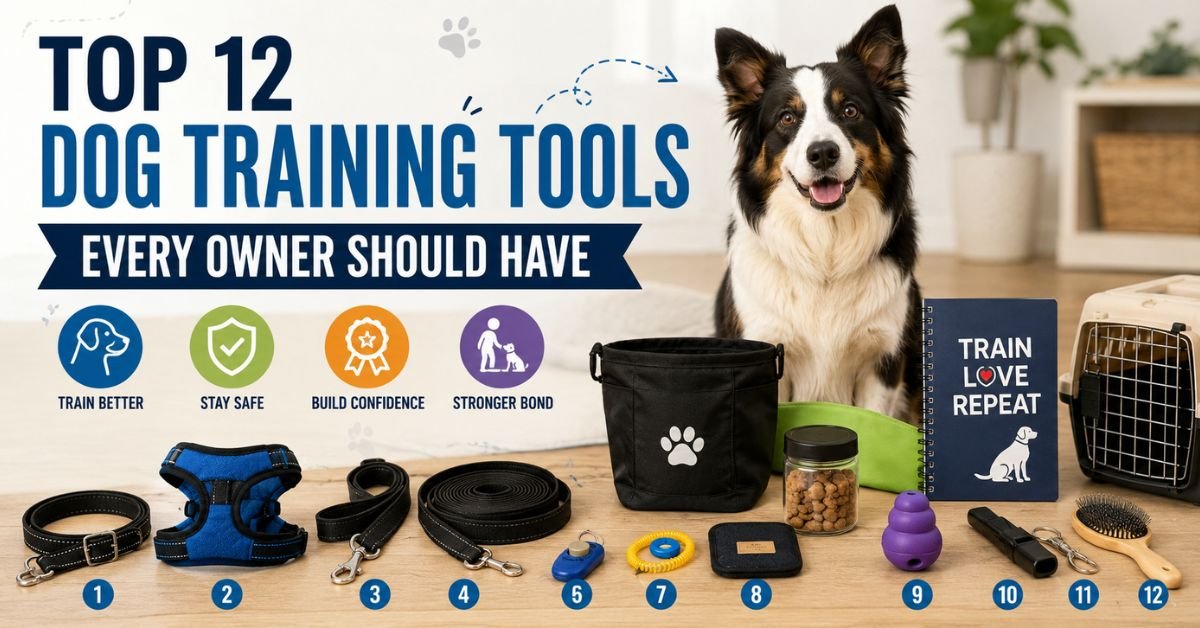
Training a dog successfully isn’t about dominance, expensive gadgets, or spending hours repeating commands. The right tools can dramatically improve communication, build trust, and make training safer and more enjoyable for both dogs and their owners.
The Top 12 Dog Training Tools Every Owner Should Have aren’t necessarily the most expensive products on the market. They’re the tools that professional trainers, veterinarians, and experienced dog owners repeatedly rely on because they support clear communication, positive reinforcement, and long-term behavioral success.
Whether you’re raising a new puppy, adopting an adult rescue dog, or refining your dog’s obedience skills, having the right equipment can save months of frustration.
Quick Answer:
The top 12 dog training tools every owner should have include a flat collar, front-clip harness, standard leash, long training leash, treat pouch, high-value treats, clicker, crate, interactive toys, training mat, dog whistle, and grooming rewards kit. These tools support positive reinforcement training, improve communication, increase safety, and help dogs learn faster and with less stress.
Why Using the Right Dog Training Tools Matters
Many dog owners assume that successful training depends mainly on the dog’s intelligence or breed. In reality, trainers often point out that the tools used during training significantly influence learning outcomes.
The right training equipment helps by:
- Improving communication between dog and owner
- Increasing safety during outdoor training
- Preventing frustration and confusion
- Encouraging positive reinforcement
- Building confidence in fearful or reactive dogs
- Supporting consistency throughout training
Poor equipment choices can create unintended problems. For example:
- Retractable leashes often encourage pulling.
- Ill-fitting harnesses may restrict movement.
- Low-value treats reduce motivation.
- Inconsistent reward delivery slows learning.
Comparison Table: Essential Dog Training Tools at a Glance
| Tool | Primary Purpose | Best For | Skill Level |
| Flat Collar | Identification and basic control | All dogs | Beginner |
| Front-Clip Harness | Loose-leash walking | Pullers and puppies | Beginner |
| Standard Leash | Daily obedience training | All dogs | Beginner |
| Long Training Leash | Recall training | Intermediate training | Intermediate |
| Treat Pouch | Fast reward delivery | Positive reinforcement | Beginner |
| High-Value Treats | Motivation | All training stages | Beginner |
| Clicker | Marker training | Precision behaviors | Intermediate |
| Crate | House training and safety | Puppies and adults | Beginner |
| Interactive Toys | Mental stimulation | High-energy dogs | Beginner |
| Training Mat | Place training | Household manners | Beginner |
| Dog Whistle | Distance communication | Recall and field work | Advanced |
| Grooming Rewards Kit | Cooperative care | Grooming and vet visits | Beginner |
1. Flat Collar: The Foundation Tool
A quality flat collar remains one of the most important pieces of dog equipment.
Its primary functions include:
- Holding identification tags
- Maintaining control during routine handling
- Supporting basic obedience training
- Providing emergency restraint when necessary
Look for:
- Adjustable sizing
- Durable buckles
- Lightweight materials
- Proper fit (two-finger rule)
Many professional trainers recommend avoiding overly tight collars because discomfort can create negative associations during learning.
2. Front-Clip Harness: The Best Tool for Pullers
Dogs naturally move toward pressure. Traditional back-clip harnesses sometimes encourage pulling, while front-clip harnesses redirect momentum back toward the handler.
Benefits include:
- Better control
- Reduced neck strain
- Improved leash manners
- Increased safety for puppies and seniors
Veterinarians often recommend front-clip harnesses for dogs with:
- Tracheal issues
- Neck injuries
- Brachycephalic breeds
- Older joints
3. Standard Six-Foot Leash
A fixed six-foot leash remains the gold standard for obedience training.
Why six feet?
It provides enough freedom for learning while maintaining handler control.
A good training leash should:
- Be durable
- Feel comfortable in your hand
- Resist tangling
- Provide consistent feedback
Many trainers discourage retractable leashes during obedience work because they teach dogs that pulling creates more freedom.
4. Long Training Leash
Recall training becomes much easier when using a long line.
Common lengths include:
- 15 feet
- 20 feet
- 30 feet
- 50 feet
Long leashes allow dogs to:
- Explore safely
- Practice recalls
- Learn off-leash behaviors gradually
- Build confidence
Many owners report dramatic improvements in recall reliability after consistent long-line practice.
5. Treat Pouch
Timing matters enormously in dog training.
A treat pouch allows you to:
- Deliver rewards instantly
- Maintain consistency
- Keep hands free
- Prevent fumbling
Features worth considering:
- Magnetic closure
- Waist clips
- Waterproof materials
- Multiple compartments
Professional trainers rarely conduct training sessions without one.
6. High-Value Training Treats
Food rewards remain one of the most effective learning motivators.
Examples of high-value treats include:
- Freeze-dried liver
- Small chicken pieces
- Turkey treats
- Cheese cubes
- Commercial training treats
The ideal training treat should be:
- Small
- Soft
- Highly motivating
- Quick to consume
Different dogs value rewards differently. Some owners discover that a piece of boiled chicken is more effective than expensive commercial treats.
7. Clicker Training Tool
Clicker training uses a distinct sound to mark desired behavior.
The process works because:
- Dog performs behavior.
- Click sound marks success.
- Reward immediately follows.
Benefits include:
- Precise timing
- Faster learning
- Clear communication
- Reduced confusion
According to many certified trainers, clicker training works especially well for:
- Puppies
- Trick training
- Fearful dogs
- Advanced obedience exercises
8. Crate for House Training and Safety
Crates are often misunderstood.
When introduced properly, a crate becomes:
- A safe space
- A sleeping area
- A house-training tool
- A travel aid
Benefits include:
- Faster potty training
- Reduced destructive behavior
- Easier travel
- Improved recovery after medical procedures
Crates should never be used as punishment.
Veterinary professionals frequently recommend crate training because it provides dogs with a predictable and secure environment.
9. Interactive Puzzle Toys
Mental exercise can be just as important as physical exercise.
Puzzle toys help reduce:
- Boredom
- Destructive chewing
- Excessive barking
- Separation-related behaviors
Popular puzzle activities include:
- Food-dispensing toys
- Snuffle mats
- Sliding puzzles
- Frozen enrichment feeders
Many behavior specialists recommend enrichment activities for high-energy breeds.
10. Training Mat or Place Bed
Place training teaches dogs to settle calmly on a designated surface.
This skill proves useful when:
- Guests visit
- Children are present
- Meals are served
- Owners work from home
Benefits include:
- Improved impulse control
- Reduced jumping
- Better household manners
- Lower anxiety
A portable training mat also allows dogs to generalize behaviors in different environments.
11. Dog Training Whistle
Whistles provide consistent sound cues that remain effective over long distances.
They work especially well for:
- Recall training
- Hunting breeds
- Sporting dogs
- Outdoor adventures
Advantages include:
- Consistent pitch
- Long-distance communication
- Less vocal strain
- Clear signals
Whistles require proper conditioning before becoming reliable training tools.
12. Cooperative Care and Grooming Reward Kit
Training extends beyond obedience commands.
Dogs also benefit from learning to cooperate during:
- Nail trims
- Ear cleaning
- Brushing
- Veterinary exams
- Medication administration
A cooperative care kit may include:
- Lick mats
- Soft treats
- Target sticks
- Grooming brushes
- Reward markers
Veterinary behavior experts increasingly recommend cooperative care training to reduce stress during medical procedures.
Common Dog Training Tool Mistakes
Many owners unintentionally sabotage training progress.
Common mistakes include:
Using Too Many Tools at Once
Introducing several new tools simultaneously creates confusion.
Relying on Equipment Instead of Training
No tool replaces consistency and practice.
Choosing Poorly Fitted Equipment
Improper fit can create discomfort and behavioral issues.
Inconsistent Reward Timing
Delayed rewards weaken learning.
Skipping Positive Reinforcement
Dogs learn best when success produces meaningful outcomes.
Practical Checklist: Building Your Dog Training Toolkit
✓ Purchase a properly fitted flat collar
✓ Invest in a quality front-clip harness
✓ Buy a durable six-foot leash
✓ Add a long recall training line
✓ Purchase a treat pouch
✓ Stock several high-value treats
✓ Learn basic clicker training techniques
✓ Introduce crate training gradually
✓ Add enrichment puzzle toys
✓ Teach place training using a mat
✓ Condition whistle recall cues
✓ Create a cooperative care reward system
✓ Practice short daily training sessions
✓ Track your dog’s progress weekly
When to Call a Veterinarian
Training challenges sometimes indicate underlying medical problems.
Contact your veterinarian if your dog suddenly develops:
- Aggression
- Fearfulness
- Loss of learned behaviors
- House-soiling after successful training
- Excessive vocalization
- Confusion or disorientation
- Sudden resistance to handling
- Pain during training exercises
According to veterinary guidance, behavioral changes can occasionally signal:
- Pain
- Neurological disease
- Hormonal disorders
- Vision problems
- Hearing loss
- Anxiety disorders
Early evaluation often improves outcomes.
Frequently Asked Questions
Can I train my dog successfully without special training tools?
Yes. Successful dog training depends primarily on consistency, timing, and positive reinforcement. However, proper tools can significantly improve communication, safety, and learning speed.
Are expensive dog training tools better than budget options?
Not necessarily. Many professional trainers use affordable equipment. Proper fit, durability, and consistent use matter more than price.
Should puppies use the same training tools as adult dogs?
Most tools are similar, but puppies require appropriately sized equipment and softer, age-appropriate training methods.
Are electronic collars necessary for basic obedience training?
Most veterinary behaviorists and positive reinforcement trainers agree that basic obedience can be taught successfully without electronic collars.
How many training sessions should I do each day?
Most dogs benefit from multiple short sessions lasting 5–15 minutes rather than one long session. Frequent repetition helps reinforce learning while preventing mental fatigue.
Final Thoughts
The best dog training tools don’t replace patience, consistency, or a strong relationship with your dog. Instead, they create clearer communication, improve safety, and help transform everyday interactions into learning opportunities.
Building a training toolkit doesn’t require purchasing everything at once. Start with the essentials: a quality leash, harness, treats, and a reward system. As your dog’s skills develop, additional tools can help support more advanced training goals.
Successful dog training is rarely about controlling dogs. It’s about teaching them how to succeed.

Muhammad Ahad — Passionate writer sharing informative, engaging, and easy-to-read articles across different topics. Focused on delivering valuable content that helps readers learn, explore, and stay inspired every day.