

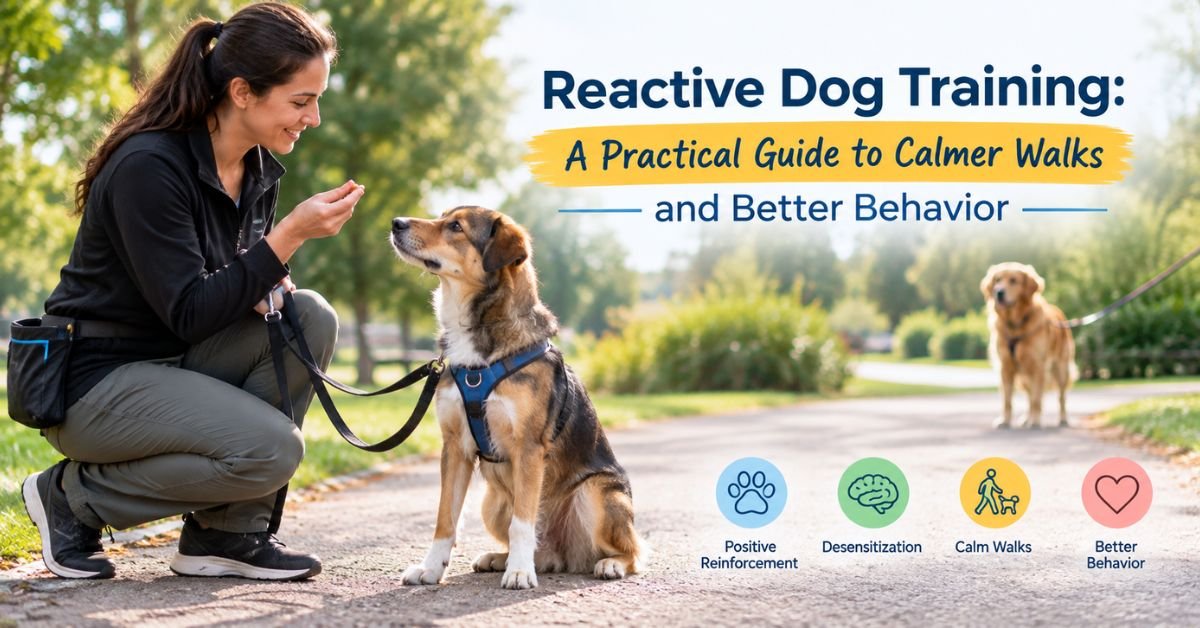
Walking a reactive dog can feel exhausting. One moment your dog seems perfectly relaxed, and the next they may bark, lunge, growl, pull hard on the leash, or become intensely focused on another dog, person, bicycle, car, or unfamiliar sound Reactive Dog Training .
For many owners, these reactions can be confusing and embarrassing. It is also easy to assume that a reactive dog is simply being aggressive or disobedient. In reality, reactivity describes an exaggerated behavioral response to a particular trigger, and the emotional cause can vary from fear and anxiety to frustration, excitement, territorial behavior, or previous negative experiences.
The good news is that reactive dog training can improve a dog’s ability to cope with difficult situations. The goal is not simply to stop barking or lunging. Effective behavior modification aims to change the dog’s emotional response while teaching practical behaviors that help the dog remain safe and manageable.
A successful plan usually combines environmental management, reward-based training, desensitization, counterconditioning, careful observation of body language, and realistic expectations. Dogs that show serious aggression, have bitten someone, or are difficult to control should receive professional behavioral and veterinary guidance.
What Is Reactive Dog Training?
Reactive dog training is a structured approach used to help dogs respond more appropriately to situations that trigger intense emotional reactions.
A reactive dog may:
- Bark repeatedly at other dogs
- Lunge toward people or animals
- Growl when a trigger approaches
- Whine, squeal, or become extremely excited
- Pull strongly toward another dog
- Freeze or stare intensely
- Spin, jump, or redirect their frustration toward the leash
- Struggle to respond to familiar cues when overwhelmed
Reactivity is not automatically aggression. A dog barking and lunging because they are frightened may be trying to create distance rather than attempting to attack. Another dog may react because they desperately want to greet another dog but become frustrated when restrained by a leash.
That distinction matters because training should address the underlying emotional response rather than simply suppress the visible behavior.
Reactive Dog vs. Aggressive Dog: What’s the Difference?
The words “reactive” and “aggressive” are often used interchangeably, but they do not mean exactly the same thing.
Reactivity describes the intensity of a dog’s response to a stimulus. Aggression refers to behavior intended to threaten, injure, or drive away another individual and can include biting, snapping, or threatening displays.
A reactive dog may never bite. A dog that displays aggression may also be reactive, but the two concepts should not be treated as identical.
Fear is one important contributor to aggressive behavior, and veterinary behavior literature emphasizes the importance of identifying the trigger, context, and underlying factors before creating a treatment plan.
Why Do Dogs Become Reactive?
There is rarely one explanation that fits every dog.
Common contributors include:
Fear and Anxiety
A dog may bark or lunge because another dog, person, vehicle, or unfamiliar situation makes them uncomfortable.
Creating distance can become the dog’s learned strategy for making the frightening situation disappear.
Frustration
Some dogs are friendly but become extremely frustrated when they cannot reach another dog or person.
This is particularly common during leash walks because the leash prevents the dog from moving freely.
Previous Negative Experiences
A frightening encounter, attack, rough handling, or other unpleasant experience can influence future responses.
A dog that was previously comfortable around dogs may become reactive after being attacked or repeatedly overwhelmed.
Insufficient Socialization
Dogs need appropriate exposure to different people, animals, environments, sounds, surfaces, and experiences.
However, socialization does not mean forcing a puppy or adult dog into crowded environments. Exposure should be safe, gradual, and appropriate for the individual dog.
Genetics and Individual Temperament
Some dogs are naturally more sensitive, excitable, cautious, or easily stimulated than others.
Breed tendencies can influence behavior, but breed alone cannot explain an individual dog’s reactivity.
Pain or Medical Problems
A sudden behavior change deserves veterinary attention.
Pain, sensory changes, neurological problems, hormonal disorders, and other medical issues can sometimes influence behavior. Veterinary behavior literature recommends considering medical contributors when evaluating significant behavior problems.
🩺 Veterinary Expert Advice & Disclaimer:
“Reactive behavior should be approached as a behavior and safety concern rather than simply a training failure. If reactivity is severe, worsening, associated with aggression or biting, or appears suddenly, have your dog evaluated by a veterinarian and consider working with a qualified veterinary behavior professional.”
— Veterinary Information Prepared for Doggopulse
Common Signs and Triggers of Reactivity
Recognizing your dog’s triggers is one of the most important parts of reactive dog training.
Common Triggers
Triggers can include:
- Other dogs
- Strangers
- Children
- Joggers
- Cyclists
- Cars and motorcycles
- Delivery workers
- Visitors entering the home
- Veterinarian handling
- Loud noises
- Doorbells
- Crowded environments
- Certain surfaces or locations
- Dogs behind fences
- Specific types of dogs
Your dog may have one trigger or several.
For example, a dog might calmly walk past people but react intensely to unfamiliar dogs. Another dog might be comfortable with dogs but become frightened when strangers approach directly.
Watch for Early Warning Signs
The most useful time to intervene is often before your dog starts barking or lunging.
Early signs can include:
- Staring
- Body stiffening
- Closed mouth
- Ears changing position
- Lip licking
- Turning away
- Sudden sniffing
- Weight shifting forward
- Tail position changing
- Increased scanning of the environment
Learning these signals allows you to create distance before the dog becomes overwhelmed.
Understanding Your Dog’s Threshold
One of the most important concepts in reactive dog training is the threshold.
A dog below threshold is sufficiently calm to notice a trigger while still being able to think, eat treats, and respond to their handler.
A dog above threshold may bark, lunge, freeze, scream, pull, or completely ignore familiar cues.
Training is generally more productive when the dog remains below threshold. Desensitization works by introducing the trigger at an intensity the dog can handle and gradually increasing the challenge.
For example:
Too difficult:
Your dog sees another dog 10 feet away and immediately explodes.
Better starting point:
Your dog sees another dog 60 feet away, notices it, and can still eat a high-value treat.
The correct distance will vary between dogs and even between different triggers.
The Foundation of Reactive Dog Training
1. Start With Management
Management is not a failure of training.
If your dog repeatedly practices barking and lunging, those behaviors can become easier to repeat.
Management may involve:
- Walking during quieter times
- Choosing less crowded routes
- Crossing the street
- Turning around before reaching a trigger
- Using parked cars or other visual barriers
- Avoiding crowded dog parks
- Creating separation from visitors
- Using baby gates inside the home
- Keeping your dog away from predictable trigger situations
Management reduces opportunities for your dog to become overwhelmed while you work on behavior modification.
2. Teach an Emergency U-Turn
A simple U-turn can be extremely useful during walks.
Start at home.
Say a cheerful cue such as “this way,” turn around, and reward your dog for following you.
Practice repeatedly in quiet environments.
Gradually introduce the behavior outdoors when there are no major triggers.
The goal is to make turning away from a difficult situation automatic rather than waiting until your dog is already reacting.
3. Teach a Reliable Attention Cue
Choose a simple cue such as “look” or your dog’s name.
Practice:
- Say the dog’s name.
- When they look toward you, mark the behavior.
- Give a reward.
- Repeat in different low-distraction environments.
- Gradually increase distractions.
Do not expect a dog to perform perfectly around a major trigger before the behavior has been practiced in easier environments.
4. Use High-Value Rewards
For difficult training situations, ordinary kibble may not be motivating enough.
Depending on your dog’s diet and veterinary needs, useful rewards may include small pieces of cooked lean meat, a portion of their normal food, or another veterinarian-approved treat.
Keep pieces small because reactive dog training can involve many repetitions.
5. Practice Desensitization
Desensitization means exposing the dog to a trigger at an intensity low enough that they can remain comfortable.
For a dog reactive to other dogs, that might mean starting at a large distance.
Over time, you can gradually decrease the distance.
Do not rush this process.
A dog that comfortably handles a trigger at 50 feet may not be ready for 20 feet during the next session.
6. Use Counterconditioning
Counterconditioning changes the emotional association with a trigger.
For example:
Other dog appears → high-value reward begins
Other dog disappears → reward stops
Repeated carefully controlled pairings can help the dog learn that the appearance of the trigger predicts something positive.
This approach is different from forcing a dog to confront a frightening stimulus. Flooding or overwhelming exposure can worsen fear and reactivity.
A Practical Reactive Dog Training Exercise
Suppose your dog reacts to other dogs.
Begin at a distance where your dog can see another dog without barking or lunging.
Step 1: Identify the Trigger
Your dog notices the other dog.
Step 2: Mark the Moment
Use a marker word such as “yes” or a clicker.
Step 3: Reward
Immediately provide a high-value reward.
Step 4: Create Space
If your dog becomes tense, increase the distance.
Step 5: Repeat
Practice multiple short repetitions rather than one long stressful session.
Step 6: Increase Difficulty Gradually
Only make the exercise harder when your dog is consistently comfortable at the current level.
This general approach is consistent with the principles of desensitization and counterconditioning recommended for changing emotional responses to triggers.
What If Your Dog Reacts During the Session?
It happens.
Do not punish your dog for reacting.
Instead:
- Stay calm.
- Increase distance.
- Use your practiced U-turn.
- Move behind a visual barrier if possible.
- Give your dog time to decompress.
- End the session if they remain highly aroused.
Punishing a fearful or anxious reaction can increase the dog’s negative association with the trigger. Reward-based behavior modification is generally preferred for these cases.
Reactive Dog Training Mistakes to Avoid
Forcing Your Dog to “Face Their Fear”
Putting a reactive dog close to their trigger in the hope that they will eventually “get used to it” can backfire.
Training should occur at an intensity the dog can handle.
Punishing Barking and Lunging
Leash corrections, yelling, or harsh punishment may suppress an outward behavior without resolving the underlying emotion.
In some cases, punishment can make the trigger itself more frightening.
Getting Too Close Too Quickly
Progress is not measured by how close your dog can get to a trigger.
Progress is measured by improved emotional control and recovery.
Training for Too Long
Short, successful sessions are often more useful than prolonged sessions in which the dog becomes increasingly stressed.
Expecting Linear Progress
Behavior improvement rarely moves in a perfectly straight line.
A dog may have an excellent week followed by a difficult walk.
Weather, fatigue, pain, unfamiliar environments, trigger intensity, and accumulated stress can all affect performance.
Trigger Stacking: Why Some Days Are Harder
Trigger stacking occurs when several stressful events accumulate before the dog has recovered from the previous ones.
For example:
- A noisy morning
- A stranger approaching too closely
- A stressful car ride
- An unfamiliar dog
- A crowded sidewalk
Each event can add to the dog’s overall stress level.
By the time the dog encounters another trigger, their ability to cope may be much lower.
On difficult days, reduce expectations and provide more distance and recovery time.
Reactive Dog Training at Home
Training does not have to happen only on walks.
Useful home exercises include:
Mat Training
Teach your dog to settle on a mat or bed.
Reward calm behavior and gradually introduce mild distractions.
Hand Targeting
Teach your dog to touch your hand with their nose.
This can become a useful redirection behavior.
Name Response
Practice rewarding your dog every time they respond to their name.
Find It
Scatter a few pieces of appropriate food on the floor and encourage your dog to sniff them out.
Sniffing can provide a simple enrichment activity and may help redirect attention in suitable situations.
Relaxation Exercises
Reward calm behaviors such as lying quietly, resting their head, or settling on their bed.
The objective is to teach your dog that calm behavior is valuable.
| Training Technique | Primary Goal | When to Use |
|---|---|---|
| Management | Prevent overwhelming reactions | Before and during everyday trigger situations |
| Desensitization | Gradually increase tolerance | When the dog can remain below threshold |
| Counterconditioning | Build a positive emotional association | When the trigger can be presented safely |
| Attention Training | Teach the dog to focus on the handler | Low-distraction practice and suitable trigger situations |
| U-Turn Training | Safely increase distance | Unexpected or unavoidable triggers |
| Mat/Settle Training | Build calm behavior | Home, visitors, waiting areas, and controlled environments |
How Often Should You Practice Reactive Dog Training?
Consistency matters more than marathon sessions.
A practical starting point may be several short training sessions throughout the week, with individual sessions lasting only as long as your dog can remain comfortable and successful.
Not every walk needs to become a training session.
Some walks should simply allow your dog to sniff, explore, and decompress in an environment that does not constantly challenge them.
How Long Does Reactive Dog Training Take?
There is no universal timeline.
Some dogs show noticeable changes relatively quickly, while others require months of consistent management and behavior modification.
The speed of progress depends on:
- The cause of reactivity
- How long the behavior has existed
- Trigger intensity
- Number of triggers
- Distance from triggers
- The dog’s individual temperament
- Training consistency
- The home environment
- Whether medical issues are present
- The skill and experience of the trainer
A realistic goal is not necessarily a dog that loves every person or dog.
A more useful goal may be a dog that can notice a trigger, remain functional, respond to their handler, and recover without exploding.
When Should You Contact a Professional?
Professional help is strongly recommended when:
- Your dog has bitten someone
- Your dog has attempted to bite
- You cannot safely control your dog
- Reactivity is getting worse
- Your dog redirects onto you
- Your dog reacts aggressively toward household members
- Children may be exposed to the behavior
- Your dog suddenly develops severe reactivity
- You are afraid to walk your dog
- Training attempts repeatedly fail
A veterinarian should be involved when a behavior change is sudden, severe, or potentially related to pain or another medical condition.
For serious cases, consider working with a veterinary behaviorist or another appropriately qualified behavior professional experienced with aggression and fear-related cases. Veterinary behavior literature also notes that medication may sometimes be used alongside behavior modification when anxiety or increased reactivity is severe.
Can Medication Be Part of Reactive Dog Treatment?
In selected cases, yes.
Medication should never be treated as a substitute for behavior modification. However, some dogs are so anxious or reactive that they cannot learn effectively while constantly overwhelmed.
A veterinarian or veterinary behavior professional can determine whether medication is appropriate.
The purpose may be to reduce excessive anxiety or arousal enough for the dog to participate more successfully in a structured behavior plan.
Medication decisions should always be individualized rather than based on another dog’s prescription.
Safety Equipment for Reactive Dogs
Depending on the individual dog, useful management equipment may include:
- A properly fitted harness
- A secure leash
- Backup attachment for strong or escape-prone dogs
- Identification tags
- A basket muzzle when professionally introduced and appropriately indicated
- Treat pouch
- High-value training rewards
- Visual barriers when practical
A muzzle should never be introduced by simply putting it onto a frightened dog and expecting them to tolerate it.
Muzzle training should be gradual and reward-based.
A Simple Weekly Reactive Dog Training Plan
Day 1: Foundation
Practice name response, hand targeting, and attention exercises at home.
Day 2: Quiet Outdoor Training
Practice the same skills in a low-distraction outdoor environment.
Day 3: Trigger Observation
Identify your dog’s comfortable threshold distance from a trigger without deliberately provoking a reaction.
Day 4: Counterconditioning
At a safe distance, pair brief trigger exposure with high-value rewards.
Day 5: Management Walk
Take a quiet walk with no expectation of close encounters.
Day 6: Short Training Session
Repeat successful exercises while keeping the difficulty manageable.
Day 7: Recovery and Enrichment
Allow your dog to relax and engage in suitable enrichment rather than repeatedly testing their limits.
This schedule is only a framework. A dog with significant aggression or severe fear may need a professionally designed behavior plan instead.
Frequently Asked Questions About Reactive Dog Training
Is a reactive dog aggressive?
Not necessarily. Reactivity can be caused by fear, anxiety, frustration, excitement, or other emotional factors. Some reactive dogs may display aggressive behavior, but barking or lunging alone does not establish that a dog intends to bite.
Can a reactive dog be trained?
Yes. Many reactive dogs can improve with appropriate management, reward-based training, desensitization, counterconditioning, and consistency. Improvement does not always mean the dog will become comfortable in every situation; practical emotional control and safe behavior are more realistic goals.
Should I punish my dog for barking or lunging?
Punishment is generally not the preferred approach for fear- or anxiety-related reactivity. Punishing a dog around a trigger may increase stress or create a stronger negative association. Creating distance and using reward-based behavior modification is generally safer and more productive.
How far away should my dog be from a trigger during training?
There is no universal distance. Begin far enough away that your dog can notice the trigger while remaining sufficiently calm to eat, think, and respond to you. The correct distance may be very large initially and should be adjusted according to your dog’s body language and behavior.
Final Thoughts
Reactive dog training is not about forcing a dog to tolerate everything.
It is about helping the dog feel safer, teaching practical skills, preventing repeated overwhelming experiences, and gradually changing their emotional response to difficult situations.
Start with management. Learn your dog’s early warning signs. Work below threshold whenever possible. Use positive reinforcement, desensitization, and counterconditioning instead of flooding or intimidation.
Most importantly, measure progress by how your dog feels and functions—not simply by whether they are completely silent.
A calmer dog is not created by one perfect training session. It is built through many small, successful experiences that teach the dog they can notice a difficult situation without immediately feeling that they need to react.
📚 Scientific References & Sources
- American Kennel Club – Changing Your Dog’s Behavior With Desensitization and Counterconditioning
- American Kennel Club – Understanding the Difference Between Reactivity and Aggression
- PubMed – Canine Aggression Toward Unfamiliar People and Dogs
- PubMed – Developing a Plan to Treat Behavior Disorders
- PubMed – A Review on Mitigating Fear and Aggression in Dogs and Cats in a Veterinary Setting

Muhammad Ahad — Passionate writer sharing informative, engaging, and easy-to-read articles across different topics. Focused on delivering valuable content that helps readers learn, explore, and stay inspired every day.
1 thought on “Reactive Dog Training: A Practical Guide to Calmer Walks and Better Behavior”