

Introduction
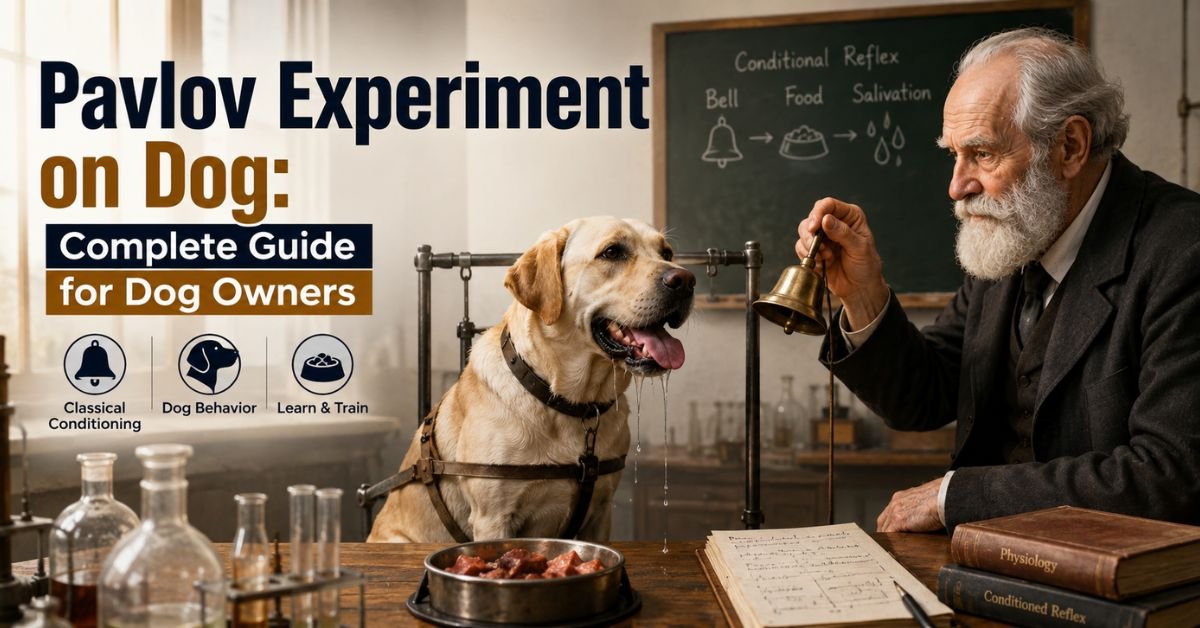
The pavlov experiment on dog is one of the most famous scientific experiments ever conducted. Even today, dog trainers, animal behaviorists, and pet owners use the principles discovered by Ivan Pavlov to understand how dogs learn.
Although Pavlov was originally studying digestion, he accidentally discovered something that changed psychology forever. His experiment showed that dogs could learn to associate one event with another, creating automatic responses through experience.
Understanding the pavlov experiment on dog can help dog owners train their pets more effectively and better understand canine behavior. In this guide, we will explore the experiment, how it worked, why it was important, and how its lessons still influence modern dog training.
What Is the Pavlov Experiment on Dog?
The pavlov experiment on dog was conducted by Russian scientist Ivan Pavlov in the late 1800s and early 1900s.
Pavlov was researching how dogs produced saliva during digestion. While observing the animals, he noticed something unusual. The dogs started salivating before food was actually presented.
They reacted to:
- The sound of footsteps
- The sight of lab assistants
- The opening of a door
- Other signals linked to feeding time
This observation led Pavlov to investigate how dogs learn through association.
Who Was Ivan Pavlov?
Ivan Pavlov was a Russian physiologist known for his work on digestion and animal behavior.
He received the Nobel Prize in Physiology or Medicine in 1904 for his research on digestive processes. However, he became even more famous for discovering classical conditioning, a fundamental concept in psychology.
His work demonstrated that learning can occur through repeated associations between stimuli and responses.
How the Pavlov Dog Experiment Worked
The experiment followed a simple but powerful process.
Step 1: Food Naturally Causes Salivation
When food was presented, dogs automatically salivated.
In this case:
| Element | Description |
| Food | Unconditioned Stimulus (US) |
| Salivation | Unconditioned Response (UR) |
The response occurred naturally without any training.
Step 2: Introduce a Neutral Stimulus
Pavlov introduced a bell sound before presenting food.
Initially:
- Bell = No salivation
- Food = Salivation
The bell had no meaning to the dog at first.
Step 3: Repeated Pairing
Pavlov repeatedly rang the bell and then immediately provided food.
The process looked like this:
- Bell rings
- Food appears
- Dog salivates
This sequence was repeated many times.
Step 4: Learned Association
Eventually, the dogs began salivating when they heard the bell alone.
Even without food present, the bell triggered the response.
This demonstrated that learning had occurred.
Understanding Classical Conditioning in Dogs
The pavlov experiment on dog introduced the concept of classical conditioning.
Classical conditioning occurs when an animal learns to associate one stimulus with another.
After conditioning:
| Component | Meaning |
| Bell | Conditioned Stimulus (CS) |
| Salivation to Bell | Conditioned Response (CR) |
The dog learned that the bell predicted food.
As a result, hearing the bell alone caused salivation.
Why the Pavlov Experiment Was Important
The experiment transformed the understanding of learning and behavior.
Before Pavlov’s work, many scientists believed behavior was mainly instinctive.
Pavlov showed that animals can learn through experience and association.
His findings influenced:
- Psychology
- Animal training
- Education
- Neuroscience
- Behavioral therapy
Today, classical conditioning remains one of the most important concepts in behavioral science.
Pavlov’s Discovery and Modern Dog Training
Many dog training methods rely on principles similar to Pavlov’s findings.
Clicker Training
Clicker training is one of the best examples.
A clicker sound becomes associated with rewards.
Over time:
- Click = Reward coming
- Dog responds positively
- Learning becomes faster
The clicker functions much like Pavlov’s bell.
Verbal Commands
Dogs learn associations between words and outcomes.
Examples include:
- “Sit”
- “Stay”
- “Come”
- “Walk”
Repeated pairings help dogs understand what these words predict.
Leash Associations
Many dogs become excited when they see a leash.
Why?
Because they associate the leash with:
- Walks
- Outdoor activities
- Fun experiences
This is another example of classical conditioning.
Everyday Examples of Classical Conditioning in Dogs
Dog owners often observe Pavlovian learning without realizing it.
Food Bowl Sounds
A dog hears food being poured into a bowl and immediately runs to the kitchen.
Opening a Treat Jar
The sound alone may excite the dog before any treat is visible.
Car Keys
Some dogs react when owners pick up car keys because they associate them with rides.
Doorbell Reactions
Dogs often bark at doorbells because the sound predicts visitors.
All of these behaviors involve learned associations.
Can Classical Conditioning Be Used for Positive Training?
Yes. In fact, it is one of the most effective ways to teach dogs.
Positive conditioning helps create desirable emotional responses.
Examples include:
- Associating strangers with treats
- Pairing grooming sessions with rewards
- Making veterinary visits less stressful
- Building confidence around new environments
Positive experiences encourage healthier behavior patterns.
Limitations of the Pavlov Dog Experiment
Although revolutionary, the experiment does have limitations.
Not All Learning Is Classical Conditioning
Dogs also learn through:
- Observation
- Trial and error
- Reinforcement
- Social interactions
Classical conditioning explains only part of the learning process.
Individual Differences Matter
There is no one-size-fits-all learning curve for dogs.
Factors include:
- Breed
- Age
- Personality
- Previous experiences
Training methods should always be adjusted to the individual dog.
Pavlov Experiment vs Modern Dog Training
| Pavlov Experiment | Modern Dog Training |
| Focused on associations | Focuses on behavior and emotions |
| Used laboratory conditions | Uses real-life situations |
| Measured salivation | Measures behavior changes |
| Basic conditioning principles | Combines multiple learning methods |
| Scientific discovery | Practical application |
Modern trainers build upon Pavlov’s foundational discoveries.
Common Misconceptions About the Pavlov Experiment
Pavlov Was Not Trying to Train Dogs
Many people think the experiment was designed to teach tricks.
Actually, Pavlov was studying digestion when he made his discovery.
The Bell Was Not the Main Goal
The bell was simply a tool used to create an association.
The real focus was understanding learning processes.
Classical Conditioning Is Not Obedience Training
Conditioning creates automatic responses.
Obedience training often requires additional methods such as reinforcement and repetition.
What Dog Owners Can Learn from Pavlov
The pavlov experiment on dog teaches several practical lessons.
Consistency Matters
Dogs learn faster when signals remain consistent.
Timing Is Important
Rewards should occur immediately after desired behaviors.
Positive Associations Work Best
Creating pleasant experiences encourages confidence and cooperation.
Repetition Builds Learning
Repeated experiences strengthen associations over time.
These principles remain central to effective dog training today.
Conclusion
The pavlov experiment on dog remains one of the most influential studies in the history of science. Ivan Pavlov’s discovery of classical conditioning revealed that dogs can learn through association, forming connections between events and responses.
Today, these principles are used in dog training, behavior modification, and animal care around the world. Whether you are teaching basic commands, introducing new experiences, or improving your dog’s confidence, understanding Pavlov’s findings can help you become a more effective and compassionate dog owner.
By applying positive associations, consistency, and patience, you can use the same learning principles that Pavlov discovered more than a century ago to build a stronger relationship with your dog.
The pavlov experiment on dog demonstrated that dogs can learn associations between stimuli. Pavlov showed that dogs could salivate to a bell after repeatedly pairing the sound with food.
Classical conditioning is a learning process where a neutral stimulus becomes associated with a meaningful stimulus and eventually triggers a response on its own.
Dogs were ideal subjects because their salivation responses were easy to observe and measure during digestion studies.
The bell became the conditioned stimulus because it eventually triggered salivation without food being present.
Modern dog training uses similar principles by creating positive associations between cues, commands, sounds, and rewards.

Muhammad Ahad — Passionate writer sharing informative, engaging, and easy-to-read articles across different topics. Focused on delivering valuable content that helps readers learn, explore, and stay inspired every day.
1 thought on “Pavlov Experiment on Dog: Complete Guide for Dog Owners”