
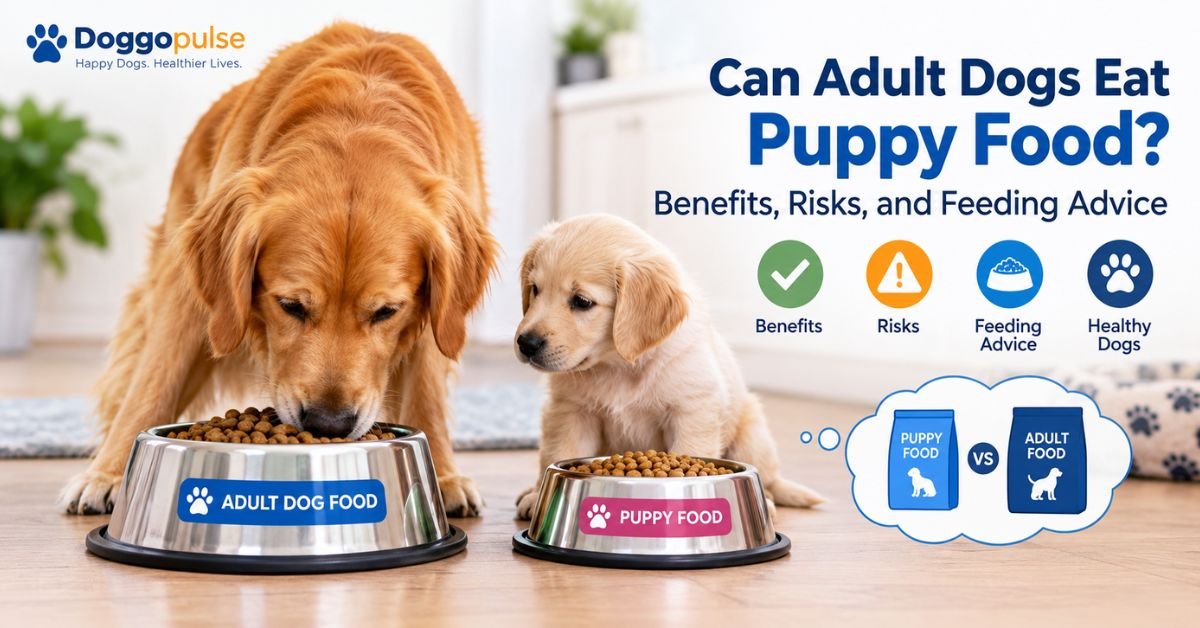
If your adult dog keeps stealing food from your puppy’s bowl, you may wonder whether it is safe. The good news is that eating a small amount of puppy food occasionally is generally not a reason to panic for a healthy adult dog. However, feeding puppy food as your dog’s regular diet is a different matter. Adult Dogs Eat Puppy Food
Puppy food is designed to support rapid growth, bone development, and the high energy demands of young dogs. Adult dogs have different nutritional needs, and many do better on a complete and balanced diet formulated specifically for adult maintenance. Some puppy foods contain more calories and fat per serving, which can contribute to unwanted weight gain when an adult dog eats them regularly.
So, can adult dogs eat puppy food safely? The answer depends on how much they eat, how often they eat it, their body condition, and whether they have any medical conditions that affect their nutritional needs.
This guide explains when puppy food is acceptable for adult dogs, the potential risks of feeding it long-term, how to choose the right food, and when to contact your veterinarian.
Overview: Can Adult Dogs Eat Puppy Food?
Yes, most healthy adult dogs can eat a small amount of puppy food without experiencing problems. Puppy food is not inherently toxic to adult dogs. The main concern is whether it provides the appropriate balance of calories and nutrients for an adult dog when fed regularly.
Puppies grow rapidly and need concentrated nutrition to develop healthy muscles, bones, organs, and other tissues. For this reason, growth diets are formulated with specific nutrient levels and energy concentrations that differ from those of many adult maintenance diets.
Adult dogs have generally completed their physical development. Their nutritional priority is to maintain a healthy weight, preserve muscle, support normal body functions, and remain active without consuming more energy than they need.
According to the Association of American Feed Control Officials (AAFCO), pet foods may be formulated for growth and reproduction, adult maintenance, or all life stages. These categories help owners identify whether a food is suitable for their dog’s stage of life.
Is Puppy Food Safe for Adult Dogs?
For most healthy adult dogs, occasional access to puppy food is generally safe. For example, if your dog eats a few pieces of puppy kibble that fall on the floor, you usually do not need to worry.
However, puppy food should not automatically replace an adult dog’s regular food. Some puppy formulas are more energy-dense, and their nutrient profile is designed around growth rather than routine adult maintenance.
An adult dog that eats puppy food every day may consume more calories than necessary, particularly if it has a low activity level or is already overweight.
There is also an important exception: some commercial foods are labeled for all life stages. These products are formulated to meet nutritional requirements across the life stages specified on their nutritional adequacy statement. They may be suitable for healthy adult dogs when fed in appropriate portions, although a veterinarian may recommend a different formula for an individual dog’s needs. Adult Dogs Eat Puppy Food
Quick Answer: Should You Feed Puppy Food to an Adult Dog?
- Occasional small amounts: Usually fine for a healthy adult dog.
- A single accidental meal: Generally not an emergency if your dog remains well and the food contains no harmful ingredients.
- Daily feeding: Usually choose a complete and balanced adult maintenance food unless a veterinarian recommends otherwise.
- Underweight or highly active adults: A higher-calorie diet may sometimes be appropriate, but the choice should be based on the dog’s individual needs.
- Dogs with health conditions: Ask your veterinarian before making puppy food a regular part of their diet.
Why Puppy Food Is Different From Adult Dog Food
Puppy food is formulated to support development. Adult dog food is generally designed to maintain the body after growth is complete.
Both can provide essential nutrients, but their calorie density, nutrient concentrations, and intended feeding amounts may differ.
1. Puppy Food May Contain More Calories
Growing puppies need substantial energy to support their developing bodies. Consequently, many puppy foods provide more calories per cup than adult maintenance foods.
This difference matters when an adult dog eats the same volume of each food. A dog that receives extra calories every day may gradually gain weight, even if it does not appear to be eating much more.
Excess weight can place additional strain on joints and make it harder for a dog to remain active. Over time, obesity may also increase the risk of several health problems.
However, not every puppy food contains more calories than every adult formula. Always compare the calorie content listed on the packaging rather than assuming all puppy foods are identical.
2. Protein and Fat Levels May Differ
Protein supports muscle maintenance, tissue repair, and normal body functions. Fat supplies concentrated energy and helps the body absorb fat-soluble vitamins.
Puppy diets are formulated to support growth, so their protein and fat concentrations may differ from those of adult maintenance diets.
That does not mean adult dogs should avoid protein or fat. Healthy adult dogs need both nutrients. The goal is to provide appropriate amounts for the dog’s size, activity, body condition, and health.
An active working dog may have different energy requirements from a less active companion dog. Therefore, the best diet is not necessarily the one with the lowest fat or highest protein percentage; it is the diet that meets the individual dog’s nutritional needs.
3. Vitamins and Minerals Must Be Properly Balanced
Calcium, phosphorus, and other minerals play important roles in skeletal development and normal body function.
Puppies have specific requirements for growth, and large-breed puppies need particular attention to calcium intake and the balance of essential nutrients. Feeding an inappropriate diet during growth can interfere with healthy skeletal development.
For adult dogs, the aim is to maintain normal body functions without providing an unnecessarily growth-focused nutritional profile.
Do not add calcium, vitamin D, or other mineral supplements to a complete and balanced dog food unless your veterinarian recommends them. Excess supplementation can be harmful.
4. Feeding Amounts May Be Different
The recommended portion on a puppy food package is intended for the product’s stated life stage. It should not automatically be used as the feeding amount for an adult dog.
For example, an adult dog that eats the same number of cups as a growing puppy may consume too many calories, depending on the food and the dog’s needs.
Check the package for calories per cup or per can, measure meals, and monitor your dog’s weight and body condition.
Potential Risks of Feeding Puppy Food to Adult Dogs
Feeding puppy food to an adult dog once is very different from making it a daily habit. The risks depend on the food, the amount consumed, and the dog’s health.
1. Unwanted Weight Gain
Weight gain is one of the main concerns when an adult dog regularly eats a calorie-dense puppy formula.
If your dog receives more energy than it uses, the excess energy is stored, primarily as body fat. This can happen gradually, so you may not notice the change immediately.
Look for these signs that your dog may be gaining excess weight:
- Its waist becomes less visible when viewed from above.
- You have difficulty feeling its ribs beneath a thin layer of fat.
- It becomes less willing to exercise.
- Its body looks rounder around the abdomen or chest.
Adjusting portions and choosing an appropriate maintenance diet can help. If your dog is already overweight, ask your veterinarian for a safe weight-management plan rather than simply reducing food drastically.
2. Digestive Upset
A sudden change in food can upset a dog’s digestive system. Depending on the individual dog, eating a large quantity of a different formula may lead to soft stools, diarrhea, vomiting, or temporary discomfort.
This does not mean puppy food is inherently difficult to digest. The change in ingredients, fat content, portion size, or eating speed may be responsible.
If your dog steals a small amount of puppy kibble and remains normal, monitoring is usually reasonable. Contact your veterinarian if vomiting or diarrhea persists, your dog becomes lethargic, or other concerning symptoms appear.
Repeated vomiting, a painful or swollen abdomen, collapse, or unproductive retching requires urgent veterinary assessment.
3. Problems for Dogs With Certain Medical Conditions
Some dogs need carefully controlled diets because of an existing health condition. For example, dogs with a history of pancreatitis may need a veterinarian-selected diet with a specific fat level. Dogs with kidney disease or other medical problems may also need individualized nutritional management.
Puppy food is not automatically appropriate for these dogs simply because it is complete and balanced for growth.
If your dog has a diagnosed medical condition, follow the prescribed feeding plan and check with your veterinarian before introducing another food.
4. Nutritional Imbalance When Food Is Not Properly Formulated
A reputable commercial puppy food that is complete and balanced for its stated life stage can provide essential nutrients. The concern is not that all puppy food is nutritionally poor for adults; it is that the food may not be the best match for an adult dog’s energy needs or medical circumstances.
Unbalanced homemade diets, inappropriate supplements, and foods that are not intended to provide complete nutrition pose different concerns. Avoid assuming that adding extra meat, calcium, or vitamins will improve a complete commercial diet.
Veterinary Expert Advice
🩺 Veterinary Expert Advice & Disclaimer:
“A small amount of puppy food is unlikely to harm most healthy adult dogs, but regular feeding should take your dog’s calorie needs, body condition, and medical history into account. If your dog has a condition such as pancreatitis, obesity, or kidney disease, consult your veterinarian before changing its diet.”
— General veterinary nutrition guidance for Doggopulse; this educational information is not a substitute for an individual veterinary examination.
When Might Puppy Food Be Appropriate for an Adult Dog?
Although adult maintenance food is usually a sensible default, there are situations in which an adult dog may be prescribed or appropriately fed a higher-energy diet.
The decision should be based on the dog’s nutritional requirements rather than on the assumption that puppy food is always better for strength, muscle, or recovery.
1. Underweight Adult Dogs
An underweight dog may need additional calories, but unexplained weight loss can be a sign of an underlying health problem.
A veterinarian may recommend a calorie-dense food, a therapeutic diet, or a specific feeding plan after evaluating the dog. Puppy food might be considered in some circumstances, but it is not a universal solution.
If your dog is losing weight despite eating normally, arrange a veterinary appointment rather than relying on extra food alone.
2. Highly Active or Working Dogs
Some working, sporting, or highly active adult dogs need more energy than a typical household pet.
However, the right diet depends on the duration and intensity of their activity, their body condition, and their tolerance of the food. A suitable adult performance diet may meet these needs more appropriately than a puppy formula.
3. Pregnancy and Nursing
Pregnant and nursing dogs have increased nutritional demands. Foods formulated for growth and reproduction may be suitable during these stages, depending on the product and veterinary advice.
This is a special nutritional circumstance, not a reason to feed puppy food to every adult dog.
4. All-Life-Stages Dog Food
Some products are formulated to provide complete and balanced nutrition for all life stages covered by their nutritional adequacy statement.
If the package states that the food is suitable for adult maintenance as well as growth, it may be an option for a healthy adult dog. Portion sizes still matter because a food designed to support growth may be more calorie-dense than the dog needs.
How to Choose the Right Food for Your Adult Dog
Choosing an appropriate diet involves more than comparing ingredient lists or selecting the most expensive product. Start with the nutritional adequacy statement, then consider calories, life stage, and your dog’s individual circumstances.
Look for an Adult Maintenance Statement
For a healthy adult dog that has finished growing, look for a food labeled as complete and balanced for adult maintenance.
In the United States, AAFCO nutrient profiles provide a framework for determining whether pet food meets nutritional requirements for its stated life stage. Other countries may have different labeling systems, so check the relevant information on the product sold in your region.
A food labeled for all life stages may also be suitable for an adult dog if its nutritional adequacy statement supports that use.
Compare Calories, Not Just Cup Sizes
Different foods provide different amounts of energy per cup or can. A cup of one formula may supply substantially more calories than a cup of another.
Check the calorie statement and adjust the portion to your dog’s needs. Use the package feeding guide as a starting point, not an inflexible rule.
Consider Your Dog’s Body Condition
An ideal-weight dog generally has ribs that can be felt without pressing hard, a visible waist from above, and an abdominal tuck when viewed from the side.
If your dog is overweight, underweight, or losing muscle, a veterinarian can help determine the appropriate daily calorie intake and food type.
Be Careful With Special Diets
Dogs with food allergies, gastrointestinal disorders, pancreatitis, kidney disease, or other health concerns may require a specific diet.
Do not replace a prescribed therapeutic food with puppy food or a generic adult formula without veterinary guidance.
Feeding Guidelines: What Should You Do if Your Adult Dog Eats Puppy Food?
The best next step depends on whether your dog ate puppy food accidentally or has been eating it regularly.
If Your Dog Ate Puppy Food Once
- Check how much was eaten. A few pieces of kibble or a small portion is generally less concerning than a large amount.
- Check the ingredients. Make sure the food is a normal commercial dog food and that your dog did not also eat packaging or another potentially harmful substance.
- Provide fresh water. Keep water available as usual.
- Watch for symptoms. Monitor for vomiting, diarrhea, abdominal discomfort, or unusual behavior.
- Contact your veterinarian if needed. Seek advice if your dog ate a very large amount, has a relevant medical condition, or develops concerning symptoms.
Do not induce vomiting unless a veterinary professional specifically instructs you to do so.
If Your Adult Dog Eats Puppy Food Every Day
If your adult dog has been eating puppy food regularly, there is usually no need to panic. Review the food label and discuss any concerns with your veterinarian, especially if your dog is overweight or has a medical condition.
If you decide to switch to adult maintenance food, transition gradually over about 5–7 days when practical. For example, begin with a small proportion of the new food mixed into the old food, then increase the new food over several days.
Some dogs need a slower transition. If your dog develops digestive symptoms, slow the change and seek veterinary advice if the symptoms are significant or persistent.
How Much Should You Feed Your Adult Dog?
There is no single portion that works for every dog. Daily calorie requirements depend on body weight, age, activity level, neuter status, metabolism, and health.
Use these steps:
- Start with the feeding guide on the selected food.
- Measure portions rather than estimating by eye.
- Count treats and table scraps as part of daily calorie intake.
- Monitor weight and body condition regularly.
- Adjust portions with veterinary guidance if your dog gains or loses unwanted weight.
Fresh drinking water should always be available.
TablePress-Ready Comparison: Puppy Food vs. Adult Dog Food
| Feature | Puppy Food | Adult Maintenance Food | What It Means for Your Dog |
|---|---|---|---|
| Main purpose | Supports growth and development | Maintains health after growth is complete | Match the food to the dog’s life stage |
| Calories | Often more calorie-dense, but varies by formula | Varies according to product and purpose | Compare calories per cup or can |
| Protein | Formulated to meet growth requirements | Formulated to meet adult maintenance requirements | Both stages need adequate protein |
| Fat | May contain more fat and energy | Varies by formula | Consider activity, body condition, and medical needs |
| Minerals | Balanced for growth; large-breed puppy formulas need special attention | Balanced for adult maintenance | Avoid unnecessary mineral supplements |
| Occasional accidental feeding | Generally tolerated by healthy adults | Appropriate for routine adult feeding | Monitor for digestive upset after a food change |
| Long-term use for a healthy adult | Not usually the first choice unless suitable for that dog | Often the preferred default | Ask your veterinarian if a special diet is needed |
| All-life-stages formula | May be labeled for multiple life stages | May also meet adult needs | Check the nutritional adequacy statement |
Common Mistakes to Avoid
Assuming Puppy Food Is Always Healthier
Puppy food is designed for growth, not to provide superior nutrition to every adult dog. More calories or higher nutrient concentrations are not automatically better once growth is complete.
Feeding by Volume Without Checking Calories
A measuring cup is useful, but portion size alone does not tell you how much energy your dog receives. Compare calorie information and monitor body condition.
Switching Foods Suddenly
Abrupt dietary changes can upset some dogs’ digestive systems. A gradual transition is often helpful unless your veterinarian recommends a different approach.
Ignoring Changes in Weight or Appetite
Unexpected weight gain, weight loss, persistent diarrhea, vomiting, or a marked change in appetite deserves attention. Do not assume these signs are caused only by the food.
Frequently Asked Questions
1. Can adult dogs eat puppy food every day?
Some adult dogs may tolerate puppy food without obvious problems, but it is generally better to choose a complete and balanced adult maintenance diet for routine feeding. Puppy food may provide more calories than a less active adult dog needs, and individual medical conditions can make the choice more important. An all-life-stages food may be suitable when its nutritional adequacy statement supports adult maintenance.
2. Will puppy food make an adult dog gain weight?
It can contribute to weight gain if it supplies more calories than the dog uses. However, weight gain depends on total calorie intake, activity, metabolism, and portion size rather than the food’s life-stage label alone. Measure meals and monitor your dog’s body condition.
3. Can puppy food upset an adult dog’s stomach?
Yes, it can cause digestive upset in some dogs, especially when they eat a large quantity or switch foods suddenly. Signs may include soft stools, diarrhea, vomiting, or abdominal discomfort. Seek veterinary advice for persistent symptoms or urgent care for severe signs such as repeated vomiting, a painful swollen abdomen, collapse, or unproductive retching.
4. Is puppy food good for an underweight adult dog?
Not automatically. An underweight dog may need additional calories, but weight loss can be caused by parasites, dental problems, digestive disorders, or other illnesses. A veterinarian can identify the cause and recommend a suitable diet. Puppy food should not be used as a substitute for investigating unexplained weight loss.
Final Thoughts
Adult dogs can usually eat a small amount of puppy food occasionally without harm, but that does not mean puppy food is the best choice for everyday feeding. Growing puppies need nutrition that supports development, while adult dogs generally need a diet that maintains a healthy body condition and meets their individual energy requirements.
For most healthy adults, a complete and balanced adult maintenance food is a practical starting point. Check calorie information, measure portions, and monitor your dog’s weight. If your dog is underweight, highly active, pregnant, nursing, or living with a medical condition, ask your veterinarian which diet is most appropriate.
The goal is not simply to feed your dog more nutrients. It is to provide the right nutrients, in the right amounts, for the life stage and health needs of your individual dog.
📚 Scientific References & Sources
- Association of American Feed Control Officials (AAFCO) – Selecting the Right Pet Food
- VCA Animal Hospitals – Nutrition: General Feeding Guidelines for Dogs
- Merck Veterinary Manual – Nutritional Requirements of Small Animals
- VCA Animal Hospitals – Your Guide to Puppy Nutrition

Muhammad Ahad — Passionate writer sharing informative, engaging, and easy-to-read articles across different topics. Focused on delivering valuable content that helps readers learn, explore, and stay inspired every day.