

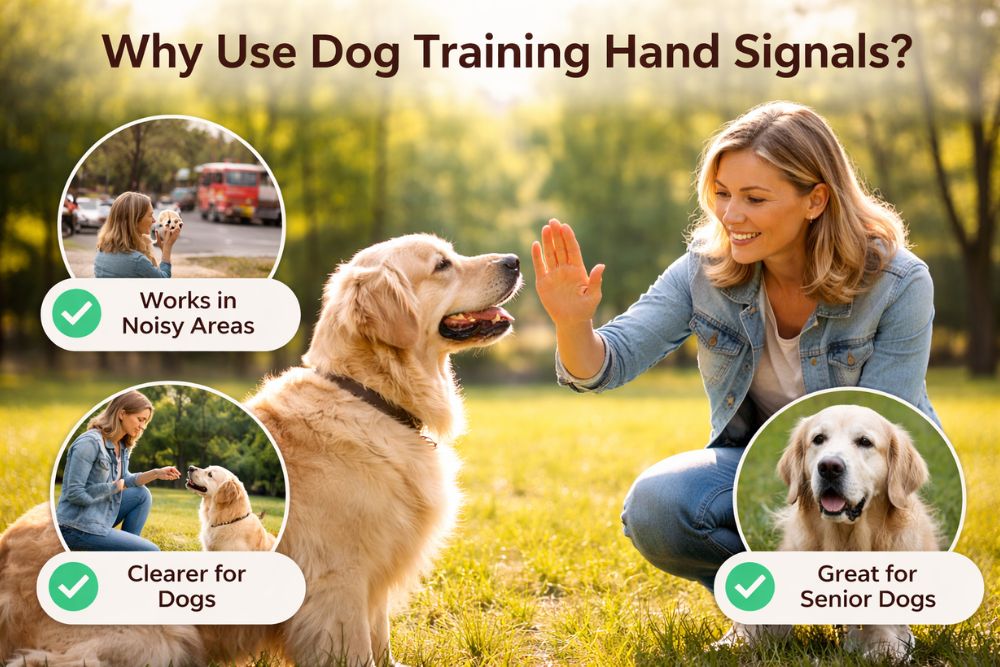
Many owners only use voice commands. That works, but it has limits. Your dog might not hear you at a busy park. Loud traffic, barking dogs, or distance can block your voice. With dog training hand signals, your dog watches and responds from anywhere.
There are three big benefits.
First, dogs read body language naturally. They communicate with each other using posture and movement. When you add hand gestures for dogs, you speak their language.
Second, silent commands build focus. A dog that watches your hands is a dog that pays attention. This strengthens your bond.
Third, non-verbal dog commands help aging dogs. Hearing loss is common in senior dogs. Teaching visual cues early prepares you for the future.
The 7 Most Useful Dog Training Hand Signals
You do not need a degree in animal behavior. Start with these seven basic moves. Each one pairs with a spoken word at first. Later, you can use just the hand signal.
1. Sit
This is the first cue most dogs learn.
The Gesture: Start with your hand at your side. Palm facing up.Lift your hand toward your shoulder and let it rest there. It looks like you are lifting food to your nose.
How to Teach: Say “Sit” and use the hand motion at the same time. When your dog sits, give a treat. Repeat ten times. Then try the hand signal alone. If your dog sits, reward big.
2. Down
Down means your dog lies flat on the belly.
The Gesture: Hold your palm flat, facing the ground. Start at your chest. Then lower your hand straight down toward the floor. Point your finger to the ground.
How to Teach: Lure your dog down with a treat in your fist. Move the treat from nose to floor. As your dog follows, use your flat palm motion. Once they lie down, say “Yes” and treat.
3. Stay
Stay keeps your dog in place until you release them.
The Gesture: Open palm facing your dog. Like a stop sign. Hold it steady for a moment.
How to Teach: Ask your dog to sit. Show your open palm and say “Stay.” Take one step back. Return and reward. Slowly add more distance and time.
4. Come (Recall)
Come is a safety command. It can save your dog’s life.
The Gesture: Start with your arm out to the side. Palm open. Then sweep your hand toward your chest. It looks like you are calling a friend to hug you.
How to Teach: Use a long leash in a safe area. Show the signal and say “Come.” Gently pull the leash if needed. When your dog reaches you, give a high-value treat.Make your guests feel welcome every time they visit.
5. Wait
Wait is different from stay. Pause, but you can move in place.” Stay means “do not move at all.”
The Gesture: Palm out, but fingers pointing up. Move your hand slightly in front of their nose. Then hold.
How to Teach: Use wait before meals or going through doors. Show your palm. Say “Wait.” Open the door. If your dog moves, close the door. Try again. Reward calm waiting.
6. Drop It
Drop it prevents your dog from eating dangerous objects.
The Gesture: Make a fist. Then open your hand quickly, palm up. It looks like you are dropping something invisible.
How to Teach: Play with two toys. Show one toy. When your dog takes it, show the hand signal and a second toy. Say “Drop it.” When they open their mouth to grab toy two, mark and reward. Practice daily.
7. Heel
Heel means walk nicely beside you without pulling.
The Gesture: Pat your left hip or thigh with your open palm. Keep your arm relaxed.
How to Teach: Start walking. Show the hip pat. When your dog walks beside you, reward with treats at your seam. Stop moving when they pull. Only walk forward when they return to your side.
Quick Reference Table: Dog Training Hand Signals
Use this table for daily practice. Download it or print it.
| Command | Hand Signal | Best For |
| Sit | Palm up, raise hand toward shoulder | Puppies, impulse control |
| Down | Flat palm, lower hand to floor | Settling, calm behavior |
| Stay | Open palm facing dog (stop sign) | Safety, door manners |
| Come | Arm out, sweep hand to chest | Recall, emergency stop |
| Wait | Palm out, fingers up (hold) | Thresholds, meal time |
| Drop It | Fist to open palm (dropping motion) | Toy trading, safety |
| Heel | Pat left hip or thigh | Loose-leash walking |
How to Transition from Voice to Silent Dog Training Cues
You might wonder, “Do I stop using my voice?” No. Keep both. But you want your dog to respond to the hand signal alone.
Follow these four steps.
Step 1: Pair voice + hand signal. Whenever possible, do both simultaneously. Say “Sit” while raising your palm. Do this for two days.
Step 2: Use hand signal first. Show the hand signal. Wait two seconds. Then say the word. Your dog will start predicting the word.
Step 3: Hand signal only. Show the gesture. Stay silent. If your dog obeys, give a jackpot reward (three treats fast). If they hesitate, go back to Step 2.
Step 4: Add distance and distractions. Practice in the backyard. Then the park. Then with other dogs nearby. The goal is a reliable visual dog training response anywhere.
Common Mistakes with Non-Verbal Dog Commands
Even great owners make these errors. Avoid them for faster results.
- Inconsistent gestures. One day you raise your right hand. Next day your left. Dogs get confused. Pick a hand and stick to it.
- Moving too fast. Slow down your signals. A quick wave looks different to a dog than a clear, deliberate motion.
- Skipping rewards. Hand signals are new. If you stop treats too soon, your dog will lose motivation. Keep rewarding for two weeks.
- Blocking eye contact. Do not hide your hands behind your back or in pockets. Make sure your dog can see your palm clearly.
Teaching Hand Gestures for Dogs with Hearing Loss
If your dog is deaf or losing hearing, visual cues become essential. The good news? Most dogs learn hand signals faster than words.
Here are three pro tips for deaf dogs.
Use a flashlight or vibration collar to get their attention first. Once they look at you, give the hand signal.
Always face your dog. Do not give cues from behind. Deaf dogs need to see your face and hands.
Use big, clear movements. A small finger wiggle is hard to see. Use your whole arm. Over time, you can make the gestures smaller.
Advanced Paw Signals for Competition or Fun
Once your dog knows the basics, try these fun extras.
Spin: Point your finger in a circle like a lasso.
Touch (nose target): Hold two fingers out like a target stick.
Crawl: Make a crawling motion with flat fingers on the floor.
Play dead: Finger gun motion (friendly version) then drop hand.
These advanced canine visual cues impress friends and give your dog mental exercise.
Real-Life Benefits of Dog Obedience Signs
Picture this. You are at a café. Your dog is lying under the table. A child runs by with a dropped hot dog. Without yelling, you give a silent “Leave it” hand signal. Your dog looks away. No drama.
Or imagine walking past a reactive dog behind a fence. Your dog starts to stiffen. You show a “Watch me” hand signal (point two fingers to your eyes). Your dog checks in with you. You walk past calmly.
Hand signals give you control without stress. They also help in vet offices, crowded streets, and during video calls when you cannot speak.
Conclusion
Dog training hand signals are a powerful tool for every owner. They improve focus, help deaf dogs, and give you silent control in loud places. Start with sit, down, and stay. Practice for five minutes daily. Use the table above as your cheat sheet.
Remember: dogs watch you more than they listen to you. Use that to your advantage. Be clear. Be consistent. And always reward success.
Now go teach your pup a high-five… with your hands, not your voice.
You can start at 8 weeks old. Puppies learn visual cues very quickly. Older dogs also learn well. Age is not a barrier.
No. That confuses your dog. Pick one clear gesture per command. Be consistent across all family members.
Most dogs learn one signal in 3–5 short sessions (5 minutes each). Mastery with distractions takes 2–4 weeks of daily practice.
Neither is “better.” They work best together. Hand signals are more reliable at a distance or in noise. Voice is easier indoors. Use both.
That is normal at first. Fade the treat by hiding it behind your back. Show the empty hand signal. Then reach for the treat after they obey.

Muhammad Ahad — Passionate writer sharing informative, engaging, and easy-to-read articles across different topics. Focused on delivering valuable content that helps readers learn, explore, and stay inspired every day.
1 thought on “Why Use Dog Training Hand Signals?”