

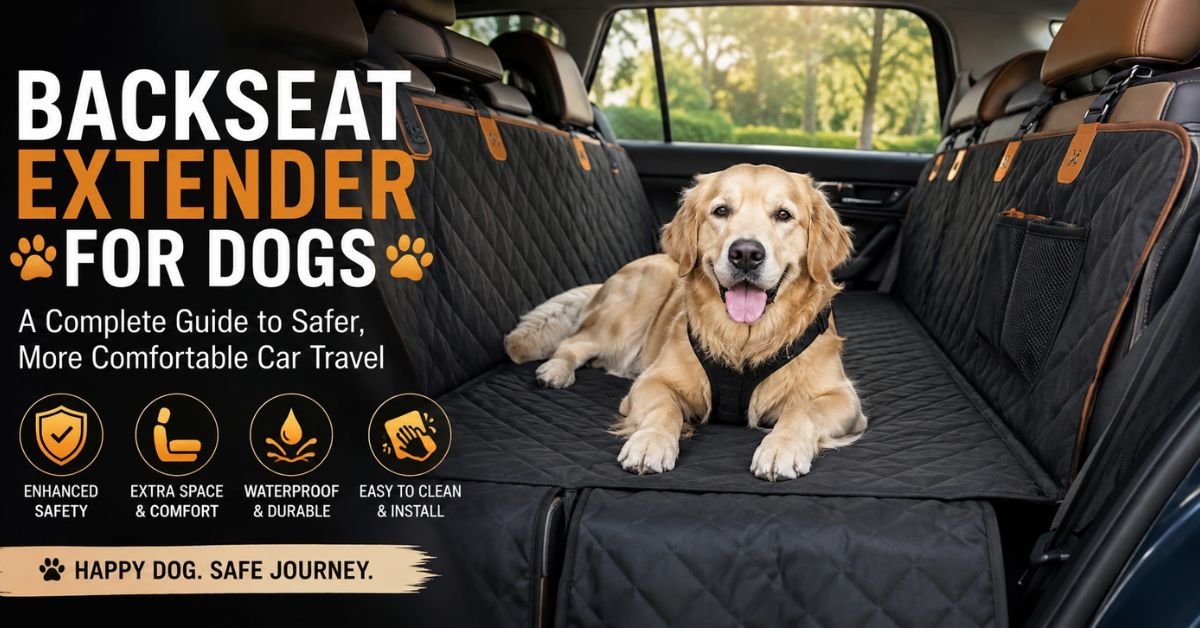
Dogs often enjoy going wherever their family goes, but a standard vehicle back seat is not always designed for a four-legged passenger. One problem appears repeatedly: the open footwell between the rear seat and the front seats. A dog may slide into that space during braking, lose balance on a turn, or become uncomfortable while trying to lie down. A backseat extender for dogs is designed to turn more of the rear passenger area into a usable resting platform.
The idea is simple, but choosing and using one safely requires more thought than many buyers realize. A padded surface can improve comfort, while a hard-bottom platform can help support a larger dog. Yet neither automatically provides crash protection or replaces proper restraint.
For some dogs, the right setup can make car rides calmer and more comfortable. For others, especially puppies, giant breeds, senior dogs, or dogs with anxiety, the best solution may involve an extender combined with training, a suitable harness, or an appropriately secured crate.
Quick Answer: A backseat extender for dogs fills the gap between the rear seat and front seats, creating a larger and flatter travel area. It can improve comfort and reduce the chance of a dog stepping into the footwell, but it is not a replacement for a proper vehicle restraint. Choose a stable, well-fitted model and use appropriate safety equipment for your dog.
What Is a Backseat Extender for Dogs?
A backseat extender is an accessory that expands the usable floor area of a vehicle’s rear seating space. Depending on the design, it may consist of:
- A hard support board
- A structured panel supported by straps
- A rigid frame beneath a seat cover
- A reinforced hammock-style platform
- A padded surface that bridges the rear footwell
Many people refer to these products by different names. You may see them marketed as a dog car hammock extender, dog backseat bridge, back seat gap filler, or hard-bottom dog hammock.
Their main purpose is not complicated: instead of leaving a deep space below the dog’s paws, the extender creates a broader surface that allows the dog to sit or lie down more naturally.
That difference can be especially noticeable with large dogs. A Labrador Retriever, German Shepherd, Golden Retriever, or similar-sized dog may struggle to settle when only the narrow rear bench is available. During a longer journey, having more horizontal space can make it easier to change position and rest.
However, comfort and safety should be treated as two related but separate issues.
A dog may have plenty of room to lie down and still be inadequately protected during sudden braking or a collision. The American Kennel Club recommends proper restraint for dogs traveling in vehicles, and both the AKC and Merck Veterinary Manual emphasize securing dogs rather than allowing them to move freely around the vehicle.
Why Dog Owners Choose a Backseat Extender
The popularity of these products comes from a practical problem many owners discover after taking their dog on a few car trips.
A normal rear seat gives a dog a raised bench but leaves an empty footwell in front of it. If the dog stretches forward, shifts during a corner, or braces while the car stops, one or more legs may slip into the gap.
The extender can change that experience.
It creates more usable space
The most obvious benefit is a larger resting area.
This may be particularly useful for:
- Large dogs that cannot comfortably curl up on one seat
- Long-bodied breeds
- Dogs traveling with blankets or beds
- Senior dogs that need a more stable resting position
- Dogs that repeatedly shift around during trips
A dog does not always need a bigger vehicle to travel more comfortably. Sometimes the existing rear space simply needs to be used more effectively.
It may reduce footwell slips
When the footwell is uncovered, a dog can misstep into it while turning around or reacting to vehicle movement.
A stable extender may reduce that particular risk by creating a continuous platform.
This does not mean every extender is equally strong. A thin fabric hammock can sag under a heavy dog. A poorly fitted board can move. Straps may loosen. A large dog can also put substantial pressure on the front edge of the platform.
Weight capacity and attachment design matter.
It can make the back seat easier to use
Dogs often prefer a predictable surface. A properly installed platform can give them more room to settle rather than constantly balancing on the edge of the seat.
For an owner, this can also mean less scrambling and repositioning.
It may protect vehicle upholstery
Many extenders are combined with seat covers that protect against:
- Mud
- Hair
- Wet paws
- Scratches
- Minor spills
This is useful, but the presence of a waterproof cover should not distract from structural safety. A product can be excellent at protecting leather seats while providing poor support for a heavy dog.
A Backseat Extender for Dogs Is Not the Same as a Safety Restraint
This is one of the most important points in the entire buying decision.
A backseat extender for dogs may make the travel area more comfortable. It does not necessarily prevent the dog from being thrown forward during sudden braking or a collision.
For safety, the dog’s travel setup should be considered as a system:
- The dog needs a stable place to sit or lie.
- The travel area should limit unnecessary distraction.
- The dog should be appropriately restrained according to the dog’s size and the equipment being used.
- The equipment should be introduced gradually if the dog is nervous about it.
The AKC advises securing dogs with appropriate equipment, such as a suitable crate or a crash-tested restraint system, rather than allowing them to ride unrestrained.
For larger dogs, the Merck Veterinary Manual advises traveling in the back seat with a harness, while smaller animals should generally be transported in carriers appropriate for the journey.
A useful way to think about an extender is this:
It improves the surface beneath the dog. It does not automatically secure the dog to the vehicle.
Common mistake: clipping a tether to a collar
A collar is not designed to distribute the force of a sudden vehicle stop across a dog’s body.
If you use a vehicle restraint, follow the manufacturer’s instructions carefully and use a harness designed for the purpose. The connection point, tether length, harness fit, and the dog’s size all matter.
Do not assume that because an extender has seat-belt openings, every harness or tether combination is automatically safe.
Types of Dog Backseat Extenders Compared
Different designs work better for different dogs and vehicles.
| Type | Best For | Main Advantage | Main Limitation |
| Soft hammock extender | Small to medium dogs | Easy to install and store | May sag under heavier dogs |
| Hard-bottom extender | Medium to large dogs | Creates a more stable platform | Requires careful weight-capacity checking |
| Foldable support board | Families needing flexibility | Can be removed or folded | Fit varies by vehicle |
| Full-width structured platform | Large dogs and long trips | Maximum usable resting space | Usually bulkier |
| Seat cover with gap support | Shorter trips and seat protection | Combines cleanliness with added coverage | May not provide enough support for heavy dogs |
Soft hammock-style extenders
These are usually made from fabric, often with straps connected to the front and rear headrests.
They can work well for lighter dogs because they help cover the open footwell and may also prevent the dog from climbing into the front area.
The problem comes when buyers assume all hammocks are equally supportive.
A large dog may create a deep sag in the middle. This can place pressure on attachment straps and reduce the usable resting area.
Hard-bottom extenders
These usually include a firm internal board, reinforced panels, or another structural support.
They are often a better option for larger dogs because they create a flatter surface.
Still, check:
- Maximum recommended load
- Board dimensions
- Whether the support spans the entire footwell
- Attachment method
- Compatibility with your vehicle
- Whether the board has a non-slip surface
A hard bottom should not mean a hard, uncomfortable surface. Many owners place a washable blanket or supportive dog bed on top, provided this does not interfere with the restraint system.
Full-width platforms
A full-width design can give a large dog a broader area to stretch out.
These may be especially helpful during long road trips, but installation deserves attention. A platform that shifts during braking can defeat the purpose of creating a stable surface.
Car-specific designs
Some extenders are advertised for SUVs, sedans, or trucks. Measure your vehicle rather than relying only on a general label.
A product designed around one interior shape may fit poorly in another.
Measure:
- Rear seat width
- Distance from the rear seat to the front seats
- Available headrest attachment points
- Location of seat-belt buckles
- Width of the door opening
How to Choose the Right Backseat Extender for Your Dog
The best product is not necessarily the one with the thickest padding or the most attractive photos.
Start with your dog.
Consider your dog’s size and weight
A 6-kilogram toy breed and a 45-kilogram large dog place very different demands on an extender.
Check the manufacturer’s stated weight limit, but do not stop there. Look at how the weight is supported.
For example:
- Is the bottom rigid or flexible?
- Is weight supported by the vehicle seat and floor?
- Are the straps simply hanging from headrests?
- Does the product spread the load evenly?
If you have a large dog, do not assume a fabric product marketed as “large” is structurally suitable for your dog’s actual weight.
Think about how your dog behaves in the car
A calm dog that lies down throughout the journey has different needs from a dog that:
- Paces
- Spins in circles
- Climbs toward the front seats
- Panics during braking
- Tries to stand constantly
- Vomits during travel
- Chews straps or fabric
For a restless dog, an extender alone will not solve the underlying problem.
If the behavior is related to travel anxiety, gradually introducing the car environment and restraint equipment is often more useful than simply buying a larger platform. VCA Animal Hospitals recommends gradual exposure and positive associations for dogs that become distressed during travel.
Check vehicle compatibility
Before ordering, confirm:
- Can the product attach securely to your headrests?
- Does your vehicle have fixed or adjustable headrests?
- Are rear seat belts still accessible?
- Will the extender interfere with child-seat anchors?
- Does it block rear-seat passengers?
- Can doors close without pressing against the product?
A product that fits one car perfectly can be unstable in another.
Look for non-slip surfaces
Dogs can become nervous when their paws repeatedly slide beneath them.
A non-slip top surface may help, particularly when:
- The dog is standing
- The road curves frequently
- The dog is getting into position
- The vehicle brakes
Adding a loose blanket can sometimes reduce traction. If you add bedding, test the setup before a long journey.
Prioritize strong attachment points
Check the:
- Strap material
- Buckles
- Stitching
- Connectors
- Support panels
- Headrest attachment system
Give the installed product a gentle manual test before allowing your dog onto it. Push down at different points.
If the structure slides, twists, collapses, or exposes a sharp edge, correct the installation or stop using it.
How to Install a Dog Car Seat Extender Safely
Installation should never be rushed five minutes before a road trip.
A practical approach is to install the extender while the vehicle is parked.
First, adjust the front seats to a position similar to the one you use while driving. Some extenders depend on the front seats for their shape and support.
Then:
- Place the extender according to the manufacturer’s instructions.
- Attach all straps to the intended headrests or anchor points.
- Tighten the straps evenly.
- Confirm that the platform does not block necessary seat-belt access.
- Test the surface with your hands before putting the dog on it.
- Add approved bedding if desired.
- Set up the dog’s restraint or crate separately.
- Let your dog investigate the setup while the car is stationary.
Do not rely on a quick glance to determine whether the product is secure.
A dog shifts its weight dynamically. Jumping into the car, turning around, and bracing during braking can put different pressure on the extender.
How to Introduce Your Dog to the Extender
Some dogs immediately climb onto a new platform. Others may stare at it as if it has appeared from another planet.
That is normal.
Start while the car is parked.
Allow your dog to inspect the new surface without pressure. Reward calm behavior. You might begin with:
- Sitting beside the car
- Getting into the rear seat
- Standing on the extender
- Lying down briefly
- Sitting in the parked car with the doors closed
- Starting the engine
- Taking a very short drive
The AKC recommends helping dogs become comfortable with restraint equipment and vehicle travel through gradual, positive training.
Do not force a fearful dog to stay
If your dog is trembling, drooling heavily, panting, trying to escape, or refusing food, forcing a longer ride may strengthen the negative association.
Instead, shorten the training step.
VCA explains that car-related distress may involve anxiety, motion sickness, or both. Gradual behavior modification and veterinary guidance may be appropriate depending on the dog’s symptoms.
Backseat Extender for Large Dogs: What Matters Most
Large dogs are where product quality becomes particularly important.
A German Shepherd, Labrador Retriever, Golden Retriever, Rottweiler, or similarly sized dog may quickly expose weaknesses in a lightweight extender.
Look beyond the words “extra large”
“Extra large” may describe dimensions rather than load-bearing strength.
Check both.
A wide product with a weak base is not automatically suitable for a heavy dog.
Watch for sagging
A small amount of flexibility may be acceptable depending on the design. Significant sagging is a warning sign.
Sagging can:
- Reduce the flat resting area
- Make it harder for the dog to balance
- Increase pressure on straps
- Encourage the dog to avoid the platform
Create a comfortable resting surface
Large dogs often benefit from supportive padding, particularly on longer trips.
However, excessive bedding can interfere with stability.
The ideal surface allows the dog to settle without causing the entire setup to shift.
Consider senior dogs carefully
Older dogs with reduced mobility may appreciate the larger platform, but getting into the vehicle can still be difficult.
A stable ramp or other mobility aid may be more appropriate than encouraging repeated jumping.
If a senior dog suddenly becomes reluctant to jump into the car, painful joints, weakness, or another health issue may be involved. An extender can make the ride more comfortable, but it does not address the cause of a sudden mobility change.
Can a Backseat Extender Help an Anxious Dog?
Sometimes, but expectations should be realistic.
A dog that dislikes car travel may feel more secure on a stable surface because there is less slipping and scrambling.
However, an extender does not treat anxiety by itself.
Car anxiety can be associated with:
- Previous nausea
- A frightening car experience
- Noise
- Vehicle motion
- Restraint
- Lack of gradual exposure
According to the Merck Veterinary Manual, motion sickness can involve nausea, drooling, vomiting, and signs of uneasiness, while fear of the vehicle can also contribute to symptoms.
VCA also notes that a dog may experience anxiety and motion sickness at the same time.
The better strategy is often:
Stable travel setup + gradual training + appropriate veterinary support when needed.
For mild anxiety, begin with short, calm sessions. Avoid making every car trip lead to something unpleasant.
If your dog only travels to the veterinary clinic, try introducing short, positive car trips when practical.
Common Mistakes Dog Owners Make
Mistake 1: Assuming the extender is a crash barrier
An extender creates space. It is not automatically engineered to protect the dog in a collision.
Mistake 2: Choosing by appearance alone
Quilted fabric, waterproof materials, and attractive designs do not tell you whether the product can support your dog’s weight.
Mistake 3: Ignoring the vehicle’s measurements
Always measure your own rear seating area.
Mistake 4: Using the product without testing it
Install it first, apply pressure manually, and watch how the structure responds.
Mistake 5: Allowing the dog to roam freely
A comfortable dog can still become a dangerous distraction.
Keep the dog appropriately secured.
Mistake 6: Leaving the dog alone in the vehicle
A backseat extender does nothing to prevent heatstroke. Cars can heat up rapidly, and cracking a window does not make an unattended vehicle safe.
Mistake 7: Ignoring motion-sickness signs
Repeated drooling, lip licking, whining, vomiting, or distress should not simply be dismissed as the dog being “bad in the car.”
These signs may warrant veterinary advice.
Practical Checklist Before Every Trip
- Check that the backseat extender for dogs is fully installed and tightened.
- Confirm that the support platform does not sag excessively under the dog’s weight.
- Make sure seat-belt access and necessary vehicle controls are not blocked.
- Test buckles, straps, panels, and support points for damage.
- Use an appropriate dog restraint or properly secured crate.
- Make sure your dog cannot enter the front seating area.
- Provide water for longer journeys and plan safe rest stops.
- Keep your dog’s identification information current.
- Watch for anxiety or motion-sickness signs before and during travel.
- Never leave your dog unattended in a parked vehicle.
- Inspect the extender after a long trip for loosened straps, tears, or structural damage.
[wp_ulike]
When to Call a Veterinarian
A backseat extender is a travel accessory, not a medical solution.
Contact a veterinarian if your dog shows repeated or severe:
- Vomiting during car travel
- Excessive drooling
- Persistent diarrhea
- Extreme panic
- Collapse or severe weakness
- Sudden balance problems
- Difficulty breathing
- Refusal to enter the car accompanied by signs of pain
- A sudden inability or unwillingness to jump that is unusual for your dog
Car sickness is particularly common in younger dogs, but ongoing symptoms should not automatically be ignored. VCA notes that some puppies may outgrow motion sickness as they mature, while other dogs may have anxiety or medical factors contributing to travel problems.
Do not give anti-nausea, sedative, or anti-anxiety medication based solely on internet advice. Your veterinarian can consider your dog’s age, weight, health history, other medications, and the specific cause of the travel problem.
Final Thoughts
A backseat extender for dogs can be a genuinely useful car accessory when chosen for the right reason.
Its strongest advantage is simple: it gives a dog more stable, usable space by covering the gap in front of the rear seat. That can improve comfort, reduce footwell slips, and make long trips easier for many dogs.
The safest approach is to treat the extender as one part of a complete travel setup. Choose a product that fits both your dog and your vehicle, check its structural support, introduce it gradually, and use an appropriate restraint or carrier rather than assuming the platform alone provides protection.
For a calm dog, the extender may make the ride more enjoyable. A large dog, it can provide much-needed space. For a nervous dog, it may contribute to a more stable environment but training and veterinary guidance may still be necessary.
The best product is not simply the biggest or most padded one. It is the one that fits securely, supports your dog’s needs, and works safely with the rest of your car-travel routine.
FAQs
1. Is a backseat extender for dogs safe?
A backseat extender for dogs can improve stability and prevent a dog from stepping into the rear footwell, but it should not be considered a replacement for a proper restraint. Safety depends on the product’s strength, installation, vehicle compatibility, your dog’s weight, and the use of appropriate restraint equipment. A stable extender can improve comfort, while a suitable crate or vehicle restraint addresses the separate issue of securing the dog during travel. Backseat Extender for Dogs
2. Are hard-bottom dog car hammocks better for large dogs?
Hard-bottom designs are often more suitable for large dogs because they can provide a flatter and more supportive surface than unsupported fabric hammocks. However, the product’s actual load capacity and construction matter more than the label. Check how the board is supported, whether the platform sags under your dog’s weight, and whether the attachment system remains stable during normal movement.
3. Can I use a dog seat belt with a backseat extender?
In many cases, yes, provided the restraint and extender can be used together without interfering with each other. The extender should not block the seat-belt connection or create unsafe tension in the restraint. Follow the manufacturer’s instructions for both products, and do not clip a travel tether to the dog’s collar when a suitable body harness is required.
4. Will a backseat extender stop my dog from falling into the footwell?
A properly fitted extender is specifically designed to cover or bridge the rear footwell, so it can reduce the chance of a dog stepping into that space. Results depend on correct installation and structural strength. Large dogs should be placed on a product that can support their full body weight without collapsing or shifting.
5. Can a backseat extender help a dog with car anxiety?
It may help some dogs by creating a more stable and comfortable surface, especially if slipping or poor footing contributes to stress. However, anxiety can also be linked to motion sickness, vehicle noise, past experiences, or fear of restraint. Gradual desensitization and positive training are often needed, and persistent distress should be discussed with a veterinarian.

Muhammad Ahad — Passionate writer sharing informative, engaging, and easy-to-read articles across different topics. Focused on delivering valuable content that helps readers learn, explore, and stay inspired every day.